
General Entrescu’s Dick in 2666: The Career of a Detail

Part of: The Deep Reader
This essay discusses Entrescu’s appearances throughout the final part of the novel.
General Entrescu’s dick sounds like an absurd subject for literary criticism, and the absurdity is part of the pleasure.
In Roberto Bolaño’s 2666, its treatment offers a remarkably concrete demonstration of literary mastery. An extravagance that can provoke the laughter of a teenage joke gradually involves us in military pride, cruelty, pity, and an argument about how a man should be remembered. The laughter keeps going through these changes.
Bolaño gives the detail witnesses, a reputation, consequences, and someone who disputes what it explains. Following those uses allows us to judge how thoroughly he has integrated the joke into the lives around it.
Military pride in a parenthesis
The measurement comes with an observer attached.
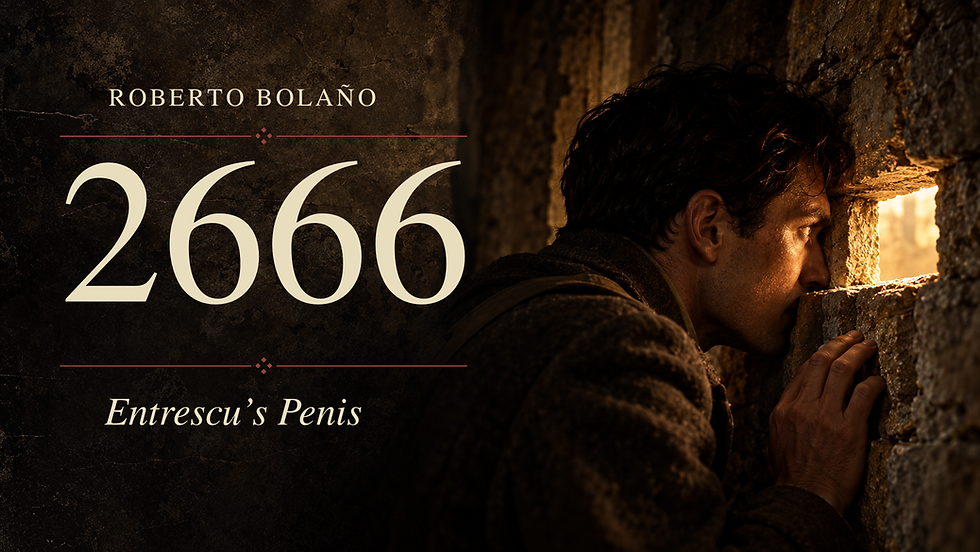
Hans Reiter, a young German soldier, and his comrade Wilke spy through a castle’s hidden passage on General Entrescu, a Romanian commander, having sex with the Baroness Von Zumpe. When the general gets up, his penis “must have measured nearly a foot long,” Wilke reflects afterward, with “his calculations on the mark.” The estimate belongs to a man remembering what he saw; the narrator then certifies its accuracy.
The phrasing moves from “must have” to certainty inside one sentence, holding together a spectator’s estimate and its certified result. The extravagance keeps the comedy of a voyeur’s reckoning while acquiring the solidity of a remembered fact within the fiction.
A later parenthesis enlarges the boast: “the famous foot-long cock, pride of the Romanian army.” The word “famous” treats the organ as though its reputation has preceded this report. “Pride” promotes a physical attribute into an institutional achievement, with an entire army apparently benefiting from that fact. The narrator can manufacture the air of a legend in the space of an aside. Military prestige becomes ridiculous without requiring an explanatory lecture about masculinity or national grandeur.
The placement keeps that prestige inside an intensely private spectacle. Entrescu recites Romanian poetry while the baroness sits astride him, and the soldiers recognize only the recurring word Dracula. They can identify the anatomy far more confidently than the literature. Reiter eventually decides that the poem must be satirical, although he cannot understand it. His pleasure helps him settle a question for which he lacks the necessary knowledge.
Bolaño also compromises the position from which the soldiers watch. Reiter initially feels disgust at Wilke’s masturbation, then begins to touch himself. Observation develops into participation at a distance. Their bodies join the rhythm of what they are watching, so the seemingly detached report of an extraordinary specimen belongs to men already absorbed in the encounter.
The soldiers’ absorption gives force to a comparative reading of the castle episode in which erotic experience takes the foreground while historical horror temporarily recedes. Within this foreground, Bolaño’s long sentence of repeated “and then” carries drinking, bodily fluids, poetry, and renewed intercourse forward together, allowing pleasure and violence to occupy the same continuous experience.
When the soldiers see blood on Entrescu’s penis, their perception is qualified: “they saw, or thought they saw.” The confidence bestowed on the measurement gives way to uncertainty. The baroness’s bitten, bleeding hand has already made violence visible, but the prose allows neither a clean assessment nor a comfortable viewing position. Pleasure continues through the blood; the spectators continue through their doubts. The report offers us an anatomical certainty inside an experience neither soldier can fully explain.
Laughter around the cross
The earlier measurement survives in the sentence describing Entrescu’s murdered body, which Reiter finds on a cross during the retreat in 1944. The general has been beaten and stripped by his own soldiers, with riding boots still on. Recognition brings the castle encounter back into the present description: the penis is still a “proud cock,” its earlier dimensions explicitly recalled through Reiter and Wilke’s reckoning, but now it “swayed wearily in the evening breeze.”
“Weary” gives the exposed flesh a suggestion of exhaustion. The lover whose stamina seemed inexhaustible has become a body moving passively in the air. “Proud” survives beside that weariness, preserving the earlier boast on the exposed, murdered body. We remember the sexual spectacle while looking at its brutally altered conditions. The language permits tenderness toward the murdered man through the very feature that made him ridiculous.
The remembered joke also becomes part of the action around the cross. German soldiers have confronted the deserting Romanians, some of whom aim their rifles at them. Reiter gets out of the vehicle and walks toward Entrescu before anyone makes the genital remark. Then a German comments on the general’s member, several Romanians laugh, and the soldiers approach the cross together.
Bolaño describes their return as if the cross has recovered a magnetic force. The joke is one of the impulses drawing the scattered men back toward a shared object of attention. In the following description, the rifles are no longer aimed at anyone; they are held like field tools. The image temporarily gives these armed men the posture of tired peasants. Remembered anatomy participates in a change of relations among people who had just been considering whether to shoot one another.
It would be too neat to credit the penis with preventing a firefight. Reiter’s approach has already interrupted the confrontation, and the novel distributes the movement across his action, the remark, the laughter, and the collective return. That distribution is part of the craft: the detail works among other causes, with enough consequence to belong to the drama.
Around the body, a Romanian says the general was not a bad sort. Men bow their heads or stare; a boy of fifteen prays. These reactions give the scene room for affection and bewilderment, even as another German continues to treat Entrescu as a remarkable specimen. The narration admits each response without making the gathering into a ceremony of reconciliation.
The omission that limits all this feeling is explicit: nobody thinks to bring him down. Eventually the soldiers resume their looting and leave the crucified man alone again. The penis has helped collect their attention, but attention creates no lasting obligation. Compassion remains possible in the scene and painfully incomplete.
The soldiers’ account adds hunger, fear, and the general’s refusal to resume command. They claim to have stayed because they loved him, a claim the narration immediately loosens with “Or something like that.” Even the cross was built before the killing and before the drinking, for reasons the speaker cannot explain. Bolaño surrounds this familiar body with motives that resist a settled account. The anatomical certainty persists within a history becoming harder to understand.
The baroness refuses the explanation
Archimboldi’s report of the death detours into a correction of what Entrescu’s size could prove. Reiter has become the writer Benno von Archimboldi, and the baroness is now his lover. In bed together, she asks whether Entrescu was naked or in uniform. Archimboldi answers by imagining what the approaching Russians could have inferred from the body, then qualifies the evidence: Entrescu was a misleading specimen of Romanian anatomy. Ordinary Romanian soldiers, he explains, differed little from Germans; the general was an exception.
The earlier national boast returns as an error a witness must correct. “Pride of the Romanian army” had let one exceptional member stand for collective distinction. Archimboldi’s account now insists on the limits of that representation, with a gratuitous French comparison extending the comic seriousness of his explanation. Even while reporting the killing, he gets drawn into sorting what the size could legitimately prove.
The baroness makes a more consequential distinction. Entrescu was a disastrous strategist, she says, and the best lover she had known. She immediately separates that judgment from the obvious explanation: “Not because of the size of his cock.” She credits his “shape-shifting quality,” remembering a crow’s cleverness in conversation and a devil ray in bed.
Her language supplies movement and variety where the soldiers’ reckoning supplied a dimension.
Through her memory, Entrescu has several forms, and the anatomical measurement loses its explanatory authority. An impressive trait can remain perfectly accurate while explaining very little about the experience of another person.
Their disagreement continues. Archimboldi credits Entrescu’s secretary with the intelligence she attributes to the general; she dismisses the secretary and imagines Entrescu as a lion inadequately equipped for his own destiny. Neither account settles him. Intimacy gives her grounds to challenge the witness, while her extravagant animal comparisons remain part of her own partial recollection.
This final dispute tests the economy of the whole construction. Bolaño has spent many words on the encounters, yet one bodily particular allows their claims on Entrescu to remain connected. Its successive uses preserve the relations among military reputation, erotic experience, public cruelty, and private memory. The castle’s boast remains recognizable on the cross, where the organ moves wearily, and in bed, where the baroness refuses to explain her pleasure by its size. The original shock survives these returns, while her objection keeps the recurring trait from settling into a fixed explanation of the man.
When Archimboldi finally admits that he watched from a secret chamber, the baroness laughs uncontrollably and connects the confession to his grand literary pseudonym. The man who helped certify Entrescu’s extraordinary body has become the object of her amused scrutiny. Her laughter returns us to the hidden passage, with the watcher exposed this time.
For the relationships surrounding Entrescu and Archimboldi, use the 2666 character and relationship guide.
Sources
Roberto Bolaño, 2666, translated by Natasha Wimmer (Farrar, Straus and Giroux, 2008), Part V, “The Part About Archimboldi”: the castle encounter, the retreat, and the postwar conversation with the Baroness Von Zumpe. English quotations follow this translation.
Alexis Candia-Cáceres, “Irradiaciones y difuminaciones de la brutalidad en La condesa sangrienta y 2666”, Aisthesis 57 (2015), DOI 10.4067/S0718-71812015000100001. The linked comparative reading supplies the account of erotic foregrounding and the lovers’ and spectators’ double gaze. The present essay extends that reading through uncertain perception, the detail’s later dramatic uses, and the baroness’s challenge to its explanatory force.


Comments