The Only Bulletproof Security Is Death: Alan Watts and the Paradox Destroying Your Mind
- David Lapadat | Music PhD

- May 24
- 11 min read
Alan Watts and the Stone: Why Absolute Security Is Another Word for Death
Consider the stone.
It does not erode with panic. It holds no dread of tomorrow. Rain dissolves it so slowly that centuries pass before anyone notices. A stone cannot be disappointed, cannot be betrayed, cannot lie awake at three in the morning rehearsing conversations that will never happen. A stone is, by every measurable standard, secure.
And dead, by the same measure.
This is the image I cannot stop returning to whenever I think about Alan Watts and his strange, slender book The Wisdom of Insecurity — a book that broke a lock I had spent years guarding.
The stone sits at the center of a brutal thesis that Watts builds with the patience of a jeweler and the force of a demolition crew: the only state of absolute security available in this universe is the state of non-existence.
Rigor mortis.
The sealed vault. The body at perfect rest because it has no body left to lose. Everything that lives — every organism that breathes, hunts, desires, grieves — is, by definition, in danger. Life and insecurity are not neighbors. They are the same phenomenon wearing different masks.
We know this.
We know this the way we know our own skeletons are inside us — intellectually, distantly, with a quiet refusal to sit with the image for too long. And so we spend our years constructing elaborate architectures of certainty: five-year plans drawn with the precision of military campaigns, career trajectories mapped like interstate highways, emotional insurance policies underwritten by the desperate belief that if we just organize hard enough, predict far enough, control tightly enough, we can engineer the danger out of being alive.
I know because I did this for years.
Every significant ambition I carried was wrapped in an obsessive scaffolding of guarantees. I did not simply want outcomes. I demanded contracts from the universe — notarized, time-stamped, ironclad assurances that the future would comply with my blueprints. And every single time — every time — the structure collapsed, and I was left standing not in the failure of the outcome itself but in the wreckage of having squeezed so hard.
The Law of Reversed Effort: Why Chasing Security Creates Anxiety
Watts called it the law of reversed effort, though the idea has older roots, tangled in Taoist and Zen Buddhist soil that he spent his life translating for Western ears.
The principle is deceptively simple. The harder you chase a thing, the faster it retreats.
Happiness pursued directly turns to phantom. Sleep demanded with urgency curdles into insomnia. Confidence summoned by force parodies itself. And security — the great modern obsession — clutched white-knuckled, generates the very anxiety it was meant to dissolve.
Hold water in an open palm and it stays. Clench your fist and it’s gone.
This is not mysticism. This is hydrology. And Watts understood that the same physics govern the inner life. The mind that insists on certainty before it will allow itself to feel at ease has created an impossible precondition for peace, because certainty does not exist in any living system.
You can no more secure your future than you can bite your own teeth or see your own eyes without a mirror. The instrument cannot operate on itself. The self that wants security is the self that must remain insecure in order to keep wanting — and if it ever achieved total security, it would, by necessity, cease to be a self at all. It would become the stone.
Watts wrote The Wisdom of Insecurity in 1951, at a peculiar hinge in Western intellectual history. The Second World War had shattered every remaining Enlightenment fantasy that rational progress could guarantee human safety.
Existentialism was filtering from Parisian cafés into the broader cultural atmosphere. Kierkegaard’s dread, Heidegger’s thrownness, Sartre’s nausea — these were not merely academic positions.
They were the emotional weather of a civilization that had watched itself build the most sophisticated machinery in human history and then use it to incinerate cities. The old securities — God, Empire, Reason with a capital R — had been exposed as contingent, fragile, mortal.
And into that void stepped an enormous, desperate hunger for new certainties: ideological replacements, pharmaceutical sedatives, economic forecasts, therapeutic protocols.
Watts saw this hunger and named it for what it was: a symptom, not a solution. The old certainties had not merely failed. Certainty itself had always been a hallucination — beautiful, necessary, deeply human, but a fiction all the same.
And no amount of replacement gods, whether political or pharmacological or financial, could fill a void that was not actually a void at all but the natural, irreducible condition of being alive.
Keats’s Negative Capability: The Genius of Tolerating Uncertainty
More than a century before Watts published his book, a twenty-two-year-old English poet dying of tuberculosis articulated something remarkably similar in a letter to his brothers.
John Keats, writing in December of 1817, coined a phrase that has haunted literature and philosophy ever since: Negative Capability. He defined it as the capacity to remain “in uncertainties, mysteries, doubts, without any irritable reaching after fact and reason.” The key word is irritable. Keats was not describing passive ignorance or lazy indifference.
He was describing a specific, disciplined, almost athletic tolerance for ambiguity — the ability to hold open questions open, to sit in the unresolved without lunging for the nearest available answer simply because the discomfort of not-knowing had become intolerable..
Keats believed this was the essential quality of genius. Not the obvious candidates — not brilliance, not erudition, not technical mastery — but the willingness to remain suspended in the space before answers arrive. Shakespeare had it. Milton did not. The distinction, for Keats, was everything.
Milton needed to be right. Shakespeare needed to be alive. Milton argued. Shakespeare inhabited. And the inhabiting — the willingness to become Hamlet and Iago and Prospero and Caliban without resolving their contradictions into a single moral position — was what made Shakespeare inexhaustible.
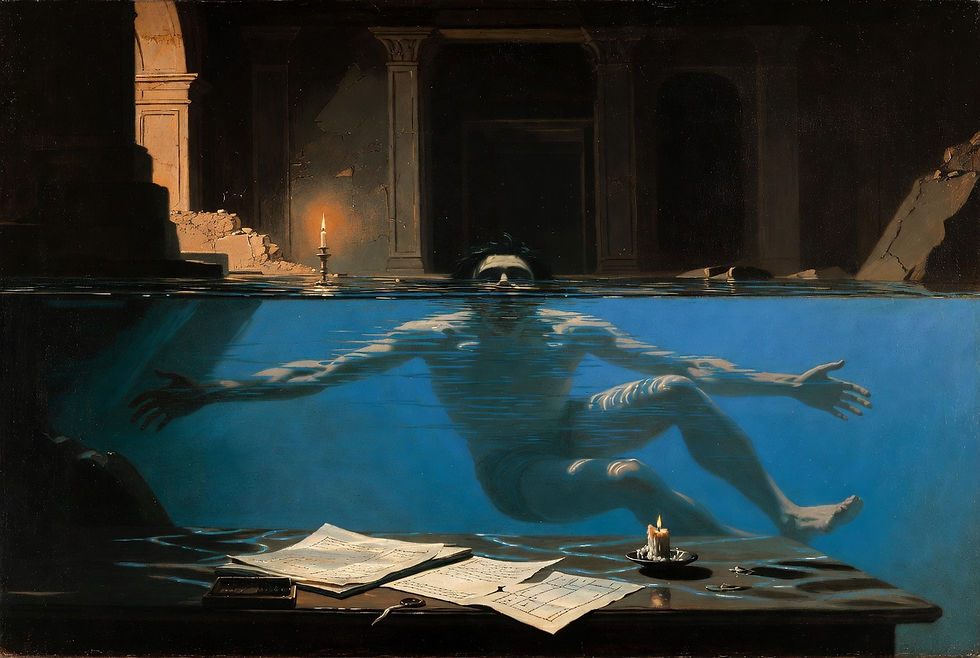
Watts and Keats never met, separated by a century and an ocean, but they were diagnosing the same illness. The irritable reaching that Keats identified in lesser poets is the same grasping that Watts identified in the modern psyche. We reach for certainty the way a drowning person reaches for anything solid — not because the solid thing will save us, but because the reaching itself feels like action, and action feels like control, and control feels like safety. But the reaching is the drowning. The grasping is the sinking.
The frantic motion we mistake for survival is the mechanism of our suffocation.
I recognize this motion in my own history with a clarity I would rather not record.
Every rigid plan I ever built was an act of grasping. Every five-year plan, every over-analyzed career move, every obsessive attempt to scenario-plan my way into emotional safety — all of it was the irritable reaching Keats warned against, performed at industrial scale, dressed up in the respectable clothing of ambition and discipline.
The Anxiety Epidemic: When the Fortress You Built Becomes Your Prison
There is a particular kind of tiredness that has nothing to do with the body.
It lives behind the eyes.
It sits in the jaw.
It accumulates from the unsleeping watch of a mind that has appointed itself sentry against an infinite perimeter of possible threats.
This is the tiredness of the person who has mistaken contingency planning for living, who has confused the map with the territory so completely that they no longer remember what it felt like to simply walk through unmapped terrain.
I believe this is the defining psychic condition of our present moment. Not sadness, despite appearances. Not fear, despite the clinical labels. A deeper kind of tiredness — a very specific, very modern exhaustion born from the relentless effort to make the uncertain certain, to convert the fluid into the fixed, to build a psychological fortress so comprehensive that nothing unpredictable can penetrate its walls.
And the fortress works — in the way that a sealed room works. Nothing gets in. But nothing gets out, either. Sealed against air, against light, against the unscripted texture of experience. The fortress becomes a prison, and the warden is the very part of you that built it. You are simultaneously the captive and the captor, locked in a structure of your own engineering, suffocating in the safety you demanded.
This is not a metaphor I am forcing onto clinical reality. The anxiety disorders that have become epidemic — and I use the word with full epidemiological weight — are misdiagnosed at the root. They are disorders of control wearing the costume of fear. The anxious mind has not encountered danger. It has refused to accept that danger is permanent, non-negotiable, and woven into the very structure of consciousness.
Anxiety, in its modern, chronic, free-floating form, is the tax levied on the soul that will not stop trying to audit the future.
And the audit never ends. It cannot end. Because the future is not an account that can be balanced. It is a weather system — chaotic, self-organizing, indifferent to your spreadsheets. Every hour spent trying to predict and control it is an hour stolen from the only moment that actually exists, which is this one, now, the one you are losing as you read this sentence because part of your mind is already rehearsing what comes next.
From the March to the Dance: Watts’s Most Liberating Metaphor
Alan Watts offered an image that broke something open in me. He said that we treat life as a journey — a march from point A to point B, with the whole value of the enterprise located at the destination.
We endure the present for the sake of the future.
We suffer through Monday for the sake of Friday, through the semester for the sake of the degree, through the career for the sake of the retirement, through the retirement for the sake of — what, exactly?
The stone. The stillness. The final security of the grave, which is the only destination that every march, without exception, reaches.
But life, Watts insisted, is not a march.
It is a dance.
And nobody dances in order to arrive at a particular spot on the floor. A dance has no final position. It exists in the dancing. The music does not deliver you to the last note — the last note is a silence, an ending, a small death. The music exists in the playing, in the space between the notes, in the way the body responds to rhythm before the mind has time to interfere.
I read that passage for the first time in a state of genuine nervous crisis — the kind that convinces you, with the quiet authority of a physician delivering terminal news, that you are fundamentally and permanently broken.
My analytical mind had done what it always did: it followed every thread of logic to its terminal point and arrived at the conclusion every honest thinker eventually reaches and then has to live with. There is no ultimate security. There may be no ultimate purpose. The universe is under no obligation to make sense to you, and it has signed no contracts about your survival, your happiness, or your plans.
Watts did not dispute any of this. He was no optimist in any conventional sense. He did not console. What he did was far more radical: he reframed the void. He took the absence of guaranteed meaning and revealed it as liberation, not catastrophe. If the march has no guaranteed destination, then the march is pointless — but the dance needs no destination to be complete.
Each step is the dance. Each breath is the arrival. The insecurity I had experienced as a prison sentence was, from a slightly different angle, an open field.
I did not become reckless. I did not abandon planning or ambition or the serious work of building things in the world.
But I stopped — gradually, imperfectly, with frequent relapses into the old grasping — demanding that the universe cosign my blueprints. I began to hold my plans the way an open palm holds water. Lightly. With the full understanding that some of it will slip through, and that the slipping is the medium, not the failure.
I now think of this as operating in dance mode. I still plan grand dances. I still choreograph ambitious sequences. But I have stopped insisting that the music play the exact melody I rehearsed, and I have stopped mistaking the end of the song for the purpose of the performance.
The purpose was always in the movement, in the weight and release, in the way the body finds its balance through continuous, responsive adjustment rather than through rigidity.
The Living and the Calcified: Why Everything Rigid Shatters
A tree in a hurricane does not stiffen. It bends. A river does not bore through stone. It curves, yields, returns. Bones, healing, do not restore the original line — they reinforce the fracture. Everything alive adapts. Everything calcified shatters.
The security I spent years building — the rigid plans, the guaranteed trajectories, the airtight forecasts — was calcification. It was the slow, voluntary conversion of a living system into mineral.
I was choosing the stone, one decision at a time. The stone does not worry. It does not grieve. It does not lie awake. But neither does it love, create, or feel the particular electricity of a moment that could go either way and then goes — gloriously, terribly, irreversibly — one way rather than another.
Watts saw that insecurity is not the obstacle to a meaningful life. It is the entrance fee. The admission is paid in uncertainty, in vulnerability, in the willingness to show up to the dance floor without a guaranteed partner and to move anyway. The people I admire most — the ones who make work that matters, who love with actual courage, who face their own disintegration with something approaching grace — are not people who have achieved security.
They are people who have stopped requiring it.
Keats died at twenty-five. His negative capability — his gift for sitting in mystery without grasping — did not save him from tuberculosis, from poverty, from the exquisite cruelty of loving Fanny Brawne without the time to build a life with her.
His tolerance for uncertainty did not make his life easier. It made his life possible. It gave him access to depths of perception that his more irritable, more certain contemporaries could never reach, because they were too busy being right to be alive.
Watts died at fifty-eight, having spent decades translating Eastern philosophy for a Western audience that simultaneously celebrated and misunderstood him. He drank too much. His personal life was complicated in ways that his critics enjoyed cataloguing and that his admirers preferred to overlook.
He did not live as a saint. He lived as a man — contradictory, flawed, genuinely brilliant, often lonely, sometimes foolish. His wisdom was not the wisdom of perfection. It was the wisdom of someone who had stared at the void long enough to notice that the void stared back with something that looked, from certain angles, remarkably like permission.
The Open Palm: Learning to Hold Plans Like Water
I do not know what happens next. I mean this in the largest possible sense. I do not know what happens to this sentence after you read it. I do not know what happens to the ambitions I am building, the relationships I am tending, the body I am inhabiting. Whether the dance I am performing has an audience, whether the music is something I am hearing or something I am generating, whether the distinction matters — none of it is mine to settle.
What I know is this: the tighter I grip, the less I hold. The more I demand certainty, the more anxious I become. The more I insist that the future conform to my plans, the more my plans become the walls of a cell I have built with my own obsessive hands.
And what I also know — what Watts gave me, what Keats confirmed across two centuries of silence — is that the letting go is not defeat. It is the first real movement. The clenched fist cannot dance. The locked jaw cannot sing.
The mind that refuses to proceed without a guarantee will never proceed at all, because the guarantee does not exist, has never existed, and the waiting for it is the only real death available to a person still technically breathing.
The stone is secure. The stone is finished. I would rather be water.


Comments