The Murder Begins in the Eye: Why King, Queen, Knave Suddenly Accelerates

Spoiler warning: This essay discusses the entire novel, including Martha’s death and the final pages.
For roughly a hundred pages, King, Queen, Knave resisted me. Its sentences kept pausing over glass, cloth, skin, rain, reflections, and shop displays, as though each surface had to be inspected before an action could cross it. Then the affair soured: Martha and Franz began discussing murder with the practical concentration of householders arranging a delivery, and the novel I had been forcing myself through became difficult to put down.
Nabokov advertises the change during the train journey that carries Franz into the Dreyers’ lives: “The first chapter of a journey is always detailed and slow.”
The sentence belongs to travel, but it also fixes the book’s tempo; while we wait for plot, Nabokov distributes attention among three passengers who cannot agree on the room they share. Revising the novel forty years later, he admitted that the Russian original had sagged and cut it heavily for English. Slack survives in the revised text, along with the patient construction of three incompatible habits of sight.
When Martha and Franz begin planning Dreyer’s murder, two of those habits converge on a single future. Their calculations turn a living man into a fixed item that can be positioned, packaged, and removed. An armchair, a gate’s spikes, the weather, a telephone call, and the weight of a wallet acquire a bearing on the death the lovers already regard as complete; under that pressure, Nabokov’s descriptive abundance gains direction without losing its density.
Three People, Three Speeds
The train compartment first belongs to Franz, whose poor eyesight divides bodies into alarming fragments. Without his glasses, edges dissolve; with them, detail returns as embarrassment, appetite, or threat. Beside him, Martha sorts what she sees by usefulness, cleanliness, and control, whereas Dreyer lunges toward anything curious—a face, a newspaper, a commercial prospect, a private joke—and grants it a momentary career in his imagination.
The narration keeps handing the same surfaces from one consciousness to another. A window can carry weather, return a face as a mirror, obstruct Franz, or tempt Dreyer, and its narrative weight changes with the person looking through it. Nabokov’s exactness is cold-bloodedly selective: Franz draws physical menace from a scene, Martha detects resistance to her arrangements, and Dreyer releases comic or commercial possibilities from whatever catches his eye. Each transfer alters what the material world can do.
In Pnin, Nabokov later uses shifts in narrative distance to revise a comic judgment. The earlier novel makes the shift itself a source of drag: a scene proceeds through one character, doubles back in another’s perception, then reappears after an interval has changed the value of a gesture or desire.
Once Martha and Franz agree to erase Dreyer, those resets acquire a common measure—their scheme—and the movement among viewpoints begins exposing whatever the scheme has missed.
The Storekeeper and the Playing Card
Dreyer’s department store turns this traffic in perception into commerce. Cloth, display figures, and speculative inventions excite the frustrated artist inside the prosperous salesman; he stages goods until the sales floor resembles a theater and merchandise appears to possess its own ambitions.
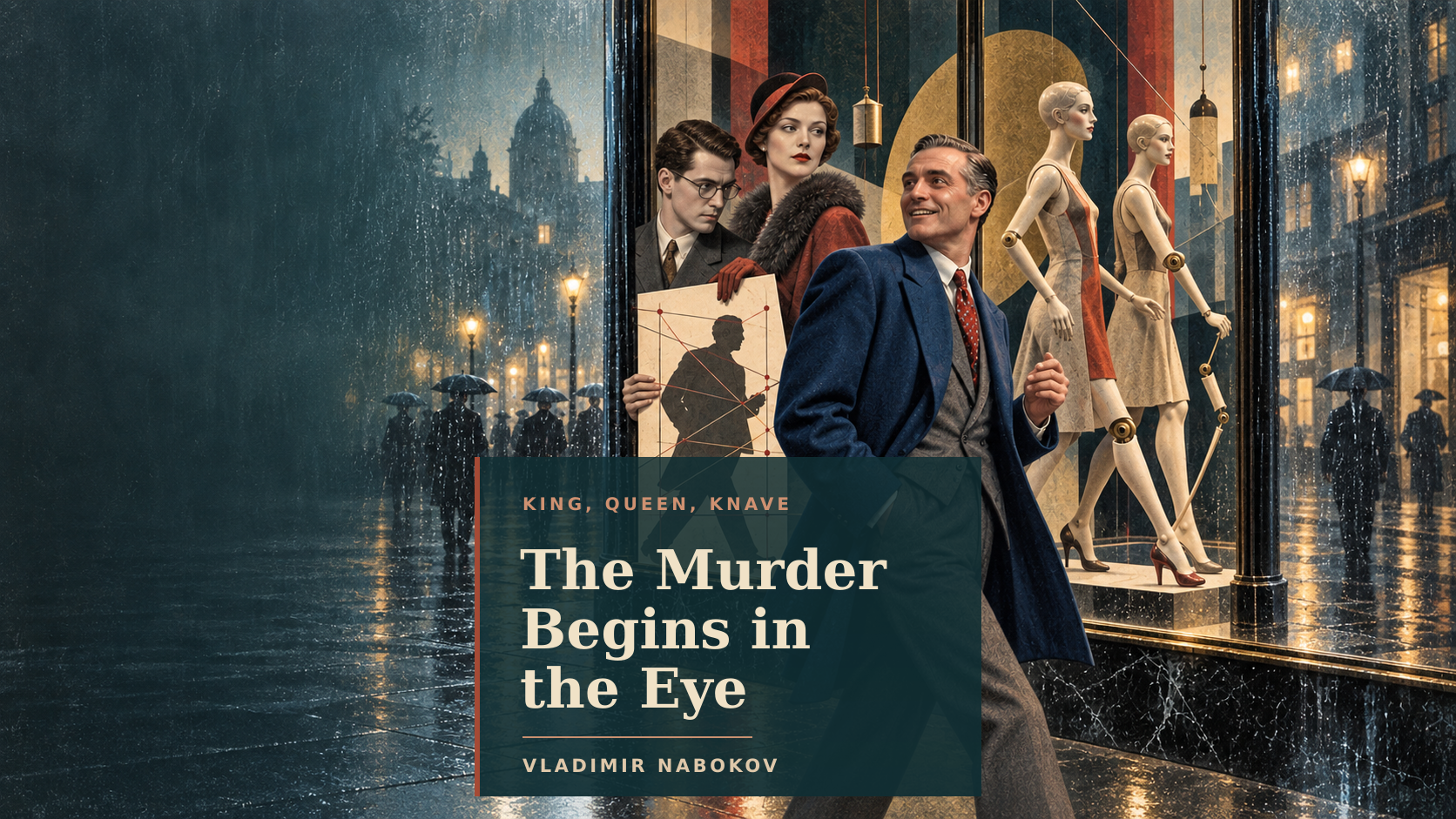
The automannequins, mechanical bodies designed to advertise clothes by walking in them, carry his appetite for animation to its logical extreme.
His curiosity also hardens quickly. Once Dreyer believes he has grasped a person’s defining trait, the narration records the change: “The bright perception became the habitual abstraction.”
Franz remains the provincial nephew, Martha the beautiful and frigid wife, and every later trait must fit the first impression.
Erica, his former mistress, gives him a domestic version of the same diagnosis when she says that he seats a person on a little shelf and assumes she will remain there after she has fallen. Dreyer replies that he noticed her hair changing from blond to red: a visible alteration has entered his memory without displacing the person he first classified.
Curiosity nevertheless leaves those categories porous enough for surprise; within a few pages Dreyer can be vain, adulterous, ludicrous, generous, commercially shrewd, and astonishingly obtuse.
Martha and Franz impose a much harder classification. As murder talk loses its shock, Franz divides his uncle into the loud, mobile man before him and a second Dreyer who is “purely schematic,” a two-dimensional playing card convenient to manipulate.
Paths, seconds, windows, furniture, weapons, and alibis fill their diagrams, while the victim remains the one fixed point because his possible response has no place there. Martha completes the conversion by imagining her husband as merchandise, tied up and ready for delivery.
Brian Boyd’s Bergsonian reading clarifies the geometry of their plan: Dreyer remains open to novelty in lived time, whereas the lovers spatialize life into an arrangement they expect to hold. The department store adds a commercial mechanism to that contrast. Dreyer animates merchandise; Martha and Franz merchandise Dreyer. Their scheme depends upon keeping that transfer one-way, with objects available for use and the victim denied any power to improvise.
The Future Recollected
Chapter eight makes the lovers’ temporal error visible in grammar. The narrator says that Dreyer has already been “several times murdered and buried”; Martha and Franz have rehearsed “not a future happiness, but a future recollection.” The past perfect gives fantasy the syntax of accomplished fact. Dreyer’s murder occurs grammatically and repeatedly although it never occurs physically, so his continued presence feels to Franz like a corpse walking back onto the stage.
That premature memory changes the affair itself. Lust had opened a clandestine world for Martha and Franz, but rehearsal strips their conversations of shame, fear, and much of their erotic charge until murder occupies the register of household management. They discuss weapons, timetables, furniture, and alibis with the weary practicality of people revising an inconvenient domestic arrangement; before they possess a workable method, repetition has taught them to inhabit the aftermath.
A future stored as recollection also changes the present. The chauffeur’s accident offers a rehearsal of death, a toy-like weapon supplies a false tool, the bare stage turns fantasy into performance, and Dreyer’s jokes sound momentarily informed. Nabokov’s hints become especially savory because Martha and Franz accept each coincidence as confirmation, while the movement among viewpoints continues to release outcomes they refuse to imagine.
Their vision narrows as the reader’s pace quickens: every selected detail now appears capable of assisting or obstructing the foregone event. When Martha complains that Dreyer has lately been “so terribly alive,” she names the surplus that invalidates her diagram, but she can read such vitality only as one more practical obstacle.
How the Automannequins Alter the Murder Plot
Dreyer buys the automannequin patent for a department-store spectacle in which mechanical figures will cross a display window wearing his clothes. In Luke Parker’s account of Weimar surface culture, the novel possesses a “shop window quality of things,” with bodies and commodities meeting on the same commercial surface. The artificial trio repeats the title’s cast in manufactured form and opens a path toward the murderous false doubles of Despair.
The machines also intervene in the murder’s timing.
While Dreyer is already in the boat from which Martha and Franz intend to drown him, he announces that an American buyer may pay a fortune for the patent. Martha postpones the killing long enough to secure the money. She leaves the boat soaked and shivering; fever, pneumonia, delirium, and death follow. Back in Berlin, the artificial woman crashes, a male dummy loses an arm, and Dreyer tires of the spectacle, although a telegram that Franz cannot decipher suggests the American deal may still close.
Leona Toker calls the Inventor’s intervention a “countermechanism” within the murder plot. Anticipated value changes Martha’s decision, the resulting delay exposes her to the weather, the dummies’ collapse accompanies hers, and their possible sale preserves Dreyer’s absurd commercial success. By acting on timing, exposure, and the fate of the scheme, artificial bodies enter causality just as Franz relinquishes his will and Martha treats her husband as movable stock.
Dreyer’s Happy and Healthy Failure
Martha’s fever carries her back into the boat scene she had rehearsed for Dreyer. In her delirium, the blue jacket refuses to sink and her husband keeps returning from directions her plan had closed. Franz receives her death as release; after offering Dreyer a counterfeit gesture of condolence, he laughs alone in his room with such violence that a stranger hears several revelers through the wall. Dreyer, blind to the plot that surrounded him, genuinely grieves the person who designed it.
The narrator’s phrase “happy and healthy failure” fits a man who survives murder, may profit from broken machines, and still loses his wife without learning what their marriage had become. Dreyer wanted the life of an artist or adventurer and settled into business, where his frustrated imagination could at least turn salesmanship into play. His obtuseness leaves him exposed to adultery, while his appetite for stray people, objects, and possibilities preserves a range of response that Martha and Franz have surrendered.
Throughout the last third, stages, rehearsals, actors, doubles, the landlord’s wig-and-stick “wife,” mirrors, and the author’s seaside cameo expose the devices from which the novel is built.
Those visible contrivances retain physical force: rain chills Martha’s body, a delayed decision changes who dies, and a garbled telegram may complete the transaction that interrupted the murder. The characters keep mistaking arrangement for mastery, even as Nabokov allows arrangements to produce consequences their designers never assigned.
The train’s first chapter moved slowly because each passenger still had a private future. Martha and Franz speed the last hours by allowing only one.
When every clock in Dreyer’s house stops, their chosen ending has already failed: rain has entered the plot, money has postponed the murder, the mannequins have spent their magic, and Dreyer—bereaved, obtuse, still curious—remains impossible to flatten into a card.
Sources
Vladimir Nabokov, King, Queen, Knave, translated by Dmitri Nabokov in collaboration with the author, revised English translation (Vintage International, 1989; translation and revision copyright 1968). Primary-text references in the essay are to chapters 1, 4–5, and 8–13 and the foreword.
Brian Boyd, Vladimir Nabokov: The Russian Years (Princeton University Press, 1990), especially the discussion of King, Queen, Knave. Boyd relates Dreyer’s openness in lived time to the lovers’ schematic reduction and spatial planning.
Leona Toker, Nabokov: The Mystery of Literary Structures, chapter 4 (Cornell University Press, 1989). Toker identifies the Inventor and automannequin thread as a plot countermechanism, including its interruption of the drowning scheme.
Luke Parker, “The Shop Window Quality of Things: 1920s Weimar Surface Culture in Nabokov’s Korol’, dama, valet”, Slavic Review 77, no. 2 (2018), 390–416. Parker situates the novel’s surfaces, display windows, and animated commodities within Weimar commercial culture.


Comments