
The Knife, The Dew, The Silence After: Kierkegaard’s Leap, the Addiction to Optionality, and What Happens When You Stop Rehearsing
- David Lapadat | Music PhD

- 14 hours ago
- 7 min read
The decisive moments of life do not arrive when certainty is highest; they arrive when certainty has run out.
Abraham climbs Moriah before dawn. The knife in his hand is wet with dew—the blood still hours away, or never—and the silence around him is the kind of silence that exists only when the world has not decided what it will become. There is no ram in the thicket. There may never be a ram in the thicket.
The entire pressure of faith, as Kierkegaard understood it, begins there: Abraham does not act because he has been given a guarantee. He acts because descending the mountain with his obedience still unspent, his life still safely hypothetical, has become more unbearable than the act itself.
Ordinary courage still implies a calculation in which the brave option wins. Abraham is carrying something stranger: the willingness to become someone whose story might end in horror, with no one else available to absorb the authorship. Kierkegaard’s Abraham terrifies because he acts without certainty. The knife matters because it is real. The dew matters because the moment has not yet resolved into meaning.
The mountain has changed shape, but the structure survives. Now the resignation letter stays in drafts. Founding documents gather digital dust. The marriage conversation keeps deferring itself into next season. The move dissolves into another round of research. Everywhere, the knife gathers dew while the hand holding it waits for a guarantee that the structure of sacrifice, by definition, cannot provide.
The Knife Still Wet With Dew
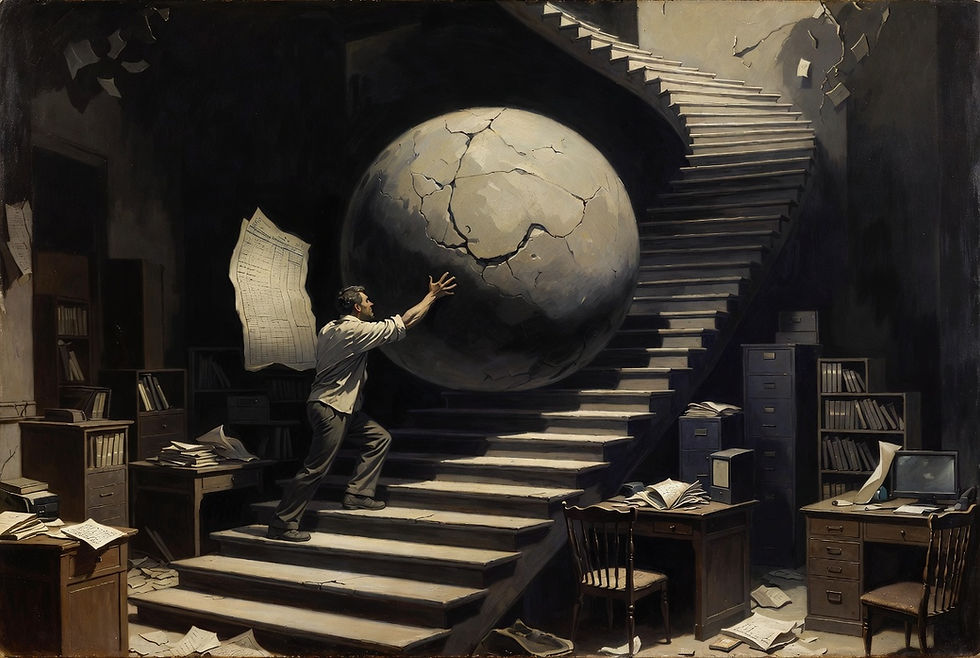
There is a peculiar hell reserved for the intelligent and the conscientious, and it looks like a well-organised desk. The tabs multiply, each one a “related article” served by the previous related article, spiraling outward until the original question—should I do this thing?—is buried beneath frameworks, counterarguments, annotated PDFs, and increasingly refined versions of avoidance. The genius of this trap is that it feels, from the inside, like responsibility.
The mechanism is simple. Every act of research resolves one uncertainty and generates two more. Knowledge widens toward adjacency as often as it narrows toward clarity. Modern information systems are designed to make that widening feel productive, so the conscientious mind moves smoothly from primary sources to expert commentary to contrarian rebuttal without ever striking the only friction that matters: the moment the laptop closes and the thing gets done.
Preparation itself is innocent. A serious person should understand the contract before signing it, the runway before leaving a job, the legal and financial consequences of a move. Real adulthood includes reading the fine print.
But there is a threshold beyond which preparation stops reducing uncertainty and starts financing deferral. The research remains active while the decision remains untouched. The person feels prudent while the actual life stays motionless.
Little of the cost is visible on a spreadsheet, and all of it is real. Opportunities expire quietly. Markets move while the tabs are still open. Relationships cool by half-degrees, and bodies age on a schedule no research can renegotiate. Even in strictly financial life, an analysis that never cashes out into allocation has crossed from prudence into paralysis. Capital kept forever in reserve eventually becomes a confession that the investor prefers the sensation of preparedness to the fact of exposure.

The Life Deferred by Optionality
A second mechanism operates less on the intellect than on the ego. Years of careful positioning produce an identity: the person who does not make rash decisions, who waits for conviction, whose restraint is legible as sophistication. This person passed on the frenzy, refused the crowded market, stayed in the role because the timing was not right. The identity feels earned, especially because impulsive disaster is easy to find and easy to mock.
But identity, like any asset, has carrying costs. The cost of maintaining strategic patience as a self-concept is that you must keep being strategically patient, even when the hour arrives that demands movement. Each month spent preserving the image of the person-who-has-not-yet-leaped raises the emotional price of leaping. To move now is to risk discovering that much of the patience was not wisdom but fear with excellent manners.
For that reason, much respectable advice becomes dangerous when smuggled into existential decisions. In portfolio management, optionality can be valuable; in uncertain markets, dry powder earns its keep. But there are regions of life where the language of perpetual optionality becomes a way of refusing incarnation. You cannot diversify a marriage, hedge a vocation, or keep five incompatible futures equally alive forever without hollowing out the present that is supposed to contain them.
Institutions reward this confusion. Employers praise steadiness right up until they do not. Families call it maturity when a person remains legible. Professional cultures celebrate the careful thinker, the measured operator, the one who keeps options open and never embarrasses himself with visible conviction. There is real value in such temperaments. But they can become a refuge for people who have made a career out of remaining uncommitted while still sounding serious.
Failure, in the abstract, can be narrated, metabolised, even exhibited. The deeper terror is exposure: that signing the papers, speaking the sentence, leaving the role, or staying and truly choosing to stay will reveal that years of disciplined-looking delay were partly performance. The act threatens something worse than a bad outcome—it will show who you were while waiting.
Everything remains technically open. The venture stays unlaunched because the partnership track might still beckon. The partnership stays unchosen because the venture may yet mature. The city remains undecided because the other city might suit better.
Over time, careful non-decision produces a kind of private balance sheet: a Forever-Option Portfolio composed of futures preserved in ideal form, each glowing warmly because none has yet been forced into the cold specificity of reality.
Financial options keep the underlying asset intact; existential options spend it. The city changes while you hesitate. The partner changes. You change. A career path available at thirty has different terms at forty. A body capable of one kind of wager carries an expiry date. And a child deferred is sometimes an altered life altogether. The optionality-rich life can become experience-poor: it holds the menu and goes hungry.

What Rehearsal Cannot Decide
The enemy, then, is the addiction to optionality. Research becomes narcotic, strategic patience hardens into dependency, and open options settle from instruments into habitat. Information, once the servant of choice, now works for the postponement: it defers the becoming of a self that would have to live with one decision instead of dreaming several.
Irrevocability is the real terror beneath the surface terrors. “What if it goes wrong?” floats on top—wrong can be survived, wrong has recovery protocols. The deeper fear is, “What if it goes wrong and it was my choice?” What if the letter was sent, the contract signed, the words spoken, and the thing that followed belongs to the chooser in a way no spreadsheet can distribute? What if the bad outcome has an author, and the author is you?
Kierkegaard wrote book after book against one consoling idea: that the self already exists somewhere underneath, waiting to be discovered like a mineral deposit. Selfhood is formed in decision. A person becomes this self and forecloses the others by choosing, and by suffering the losses that choice imposes. The leap is terrifying because it does more than select between preexisting options: it creates the chooser who will live with the result.
The leap is the abandonment of a fantasy: that the decisive moments of life can always be translated into the grammar of hedging. Every bullish bet, every rationally optimised allocation, every risk-adjusted move with acceptable downside still speaks that grammar. Abraham on Moriah has stopped speaking it. He stands inside a logic where sacrifice cannot be redeemed in advance by calculation, because a sacrifice that is already compensated is only a transaction wearing ceremonial clothing.
The Harsher Silence After Action
A stillness arrives after the leap—stillness, because peace is too polished a word for the cessation of a noise that had become so constant it was mistaken for personality. The internal committee stops meeting. The portfolio stops being rebalanced. The private theatre of self-evaluation loses power all at once. In the sudden quiet, a person hears something almost embarrassing in its simplicity: breathing in a room where nothing is being optimised.
The quiet certifies nothing—no wisdom, no promise that the decision was right, no ram in the thicket. The marriage may still fail. The business may still collapse. The move may still turn out to be a change of scenery for the same person. But a particular form of suffering ends when rehearsal ends. The suffering of indefinite postponement, of permanent self-suspension, of being answerable to futures never chosen—that suffering loses its grip the moment one future is allowed to become real.
The stillness feels unearned because it is. One decision that might be wrong bought it. That possibility of wrongness, carried forward into the future like a live coal, is what produces the rest. The coal is yours. The burn is yours. Ownership, even of a burn, is more restful than indefinite rehearsal.

Abraham descends Moriah and the text says almost nothing about what he felt—the narrative preserves the ram, as the deeper emphasis falls on the descent itself: Abraham returning to the remainder of his life with the knowledge that he was the kind of person who could lift the knife, not the kind of person who could guarantee the outcome, but the kind of person who could act without the guarantee, and that knowledge is terrible, and it is also final, the willingness having become part of the body in a way that no subsequent comfort or regret can fully undo.
The mountain, now, is a desk. The knife is a document waiting for a signature. The sacrificed thing may be a future self one is terrified of harming. But the structure still holds. The dew is real, the silence is real, and the trembling is available to anyone willing to stop rehearsing the leap and perform it—the first unrehearsed moment in a life that has until now remained dangerously hypothetical.
And yet even after the signature, even after the unrehearsed step, a stranger question surfaces. The person who finally acted may discover that the hesitation had co-authors—that something in the architecture of modern life had been training him, long before the moment of decision, to watch himself, to measure himself, to defer to a judgment that arrived before he did. The leap may have been real.
But the habits of self-surveillance that preceded it do not dissolve with a single act of will—they are structural, and they have their own history.


Comments