The People Mickey Sabbath Cannot Turn into Puppets

Updated: 3 days ago
Part of: The Deep Reader
Spoiler warning: This essay discusses the novel’s ending and several of its decisive revelations.
I read Portnoy’s Complaint a long time ago, but the irritation has stayed with me more clearly than much of the plot. I remember thinking that it was a bad book and a brilliant one at the same time. Its language did not offend me; it wore me out. Sabbath’s Theater goes further into filth and somehow never produced the same impatience. It was often funny, sometimes repellent, and, against my expectations, it made me care about Mickey Sabbath.
Mickey gives us every reason to resist the attachment. He exploits his students, invades other people’s privacy, humiliates those who shelter him, and turns almost every encounter into an occasion for sexual aggression. Age has diminished his reach without improving his character. Even grief may become another performance by a man who has spent his life provoking an audience. Caring about him never becomes approval.
We want him kept alive, still answerable to what he has done and what he has lost.
The difference from Portnoy’s Complaint begins with who controls the telling. Portnoy keeps the timing even when he imitates his mother or a lover; every rebuke arrives inside his act. Sabbath’s Theater moves in third-person prose close enough to catch Mickey’s speed without granting him the whole page. The narration can run with his talkathon and remain behind with another person’s reply or a thing his talk cannot alter. In Portnoy, excess repeatedly reconquers the scene. Here it keeps meeting people who will not disappear into it.
Still Also Nikki
Mickey’s complaint about Nikki, his first wife, is already a theory of form. Playing Madame Ranevskaya in The Cherry Orchard, she circles the empty room exactly as he instructed, touching the walls before she leaves. She does it exquisitely. Yet “whatever she played, however well, she was still also Nikki.”
The absurdity is exact. Her perfect obedience leaves a remainder Mickey cannot tolerate, a person inside the performance. The small word also preserves a second source for every gesture. Nikki may fulfill his direction, but the body carrying it still belongs to her. A puppet offers the purity he wants. Movement and voice begin in his hands, with no living intention beside his own.
Portnoy enjoys a related privilege on the analyst’s couch. The people he quotes become characters played by Portnoy, governed by his memory and comic tempo. In Sabbath’s Theater, the third-person narration keeps violating the same wish. Mickey’s idiom saturates the prose, but the pronoun he never quite vanishes. That sliver of grammar allows the sentence to follow his performance and to withdraw from it without warning.
Nikki’s later disappearance gives the artistic preference its human cost. She leaves no body, explanation, or final scene that Mickey can settle into a story. The actress who
disturbed his direction by remaining herself has carried that self beyond his reach.
Puppets do not disappear because they have nowhere else to go. Nikki does.
Years later, driving to New York for a funeral, Mickey imagines his dead mother as a marionette sent to ferry him toward death. The apparition immediately declares herself “unmastered and independent of his imagination.” His mind supplies the stage; her sentence denies his jurisdiction. Mickey’s consciousness dominates the prose without enclosing it.
What the Joke Cannot Finish
Nikki’s also is silent inside Mickey’s memory. Drenka gives it a voice. Their affair develops as an improvised repertory in which she can surprise him, outbid him, and bring stories from a sexual life that does not belong to him. They make their obscene language together while she is alive. At her bedside she gives that language its bluntest declaration, “I give my heart, I give my self, in my fucking.” Mickey can only concede that it is hard to top.
Her death has already governed the novel for hundreds of pages before Roth allows us to witness it. The bedside vigil arrives while Mickey drives north with Morty’s box beside him. Portnoy’s memories serve the momentum of his monologue; this one interrupts Mickey as the box has made another death physically present. The drive begins with specifications of Morty’s B-25, and the memory then changes direction in two clipped sentences, “Drenka. Her death.” The losses have collided before Mickey can explain them.
“Got used to” begins returning like a bodily reflex. He gets used to the oxygen prong and drainage bag, the morphine pump, the altered body, the explanations. Each return presses another horror into the grammar of routine, while the insistence of the phrase exposes how fragile that routine is. Pronouns slip among he, I, and we as recollection overtakes narration, dragging Mickey back into the false continuity of those nights.
When Drenka says that she has failed chemotherapy, he answers, “Nobody passes everything.” We laugh at the speed of the reflex and then feel how little the joke can repair. Portnoy’s jokes usually secure the next sentence for Portnoy. This one cannot.
Mickey leaves the hospital, and Drenka dies two hours later, outside the routine he thought could continue forever.
Their vocabulary survives at her grave with no answering voice. The obscenity still produces comedy, yet every successful joke now measures the silence beside it. The language that can feel exhausting in Portnoy has become the surviving half of an intimacy.
Norman’s rebuke begins at Mickey’s volume. He mocks “the discredited male polemic’s last gasp” who still treats sex as rebellion in 1994. Then the flourish subsides. “The immensity of your isolation is horrifying,” he says, almost apologetically. Mickey replies with his wit intact, but Norman’s quieter cadence remains in the room. Portnoy could quote such a line and time the punch line after it. The third-person scene permits Norman’s pity to outlast Mickey’s answer.
A Footnote That Takes Over the Page
Mickey turns other people’s voices into an archive he can classify and replay. His tapes of female students promise future audiences for what he calls his art of liberation. Kathy Goolsbee tapes one of their telephone calls too. The call now exists in two archives, and her copy escapes his control.
Roth later reproduces the exchange as a footnote that runs for pages. The main narrative has been carrying Mickey through a drunken performance of Lear in the subway; then the transcript occupies the book long after the sentence above it has disappeared. A footnote usually serves the text that summoned it. This one makes the reader submit to its duration.
Separated from Mickey’s excited account of his powers, the conversation loses the glamour he claimed for it. Kathy’s hesitations and repetitions remain audible, as does the coercive patience with which he keeps directing her speech. The exchange no longer passes through Mickey’s mimicry or condenses into a verdict. We spend its awkward time and watch a medium meant to preserve his mastery preserve the evidence alongside it.
Roseanna’s private papers impose a quieter humiliation. Mickey steals them expecting to find himself at the center of her misery and encounters the earlier damage left by her father, whose need and cruelty survive in his letters. He has injured his wife, but even his guilt had flattered him with the rank of principal author.
Drenka’s diary remains closed to him. Her furious son has read it; Mickey can only ask whether she wrote in English or Serbo-Croatian and why she preserved the record. His questions proliferate around pages he cannot absorb. Morty’s Voice-O-Graph disc grants the opposite kind of access. The brother killed during World War II speaks again about ordinary military life and the hope of coming home. The plain young voice reduces none of the grief, though it does undo the monument that grief has built around him.
Their moral circumstances differ too widely to make a chorus. Each removes some piece of another life from Mickey’s authorship. Even when he steals the page or owns the recording, he must answer to wording he did not arrange; when the diary stays closed, he must answer to silence.
The Custodian of Morty’s Things
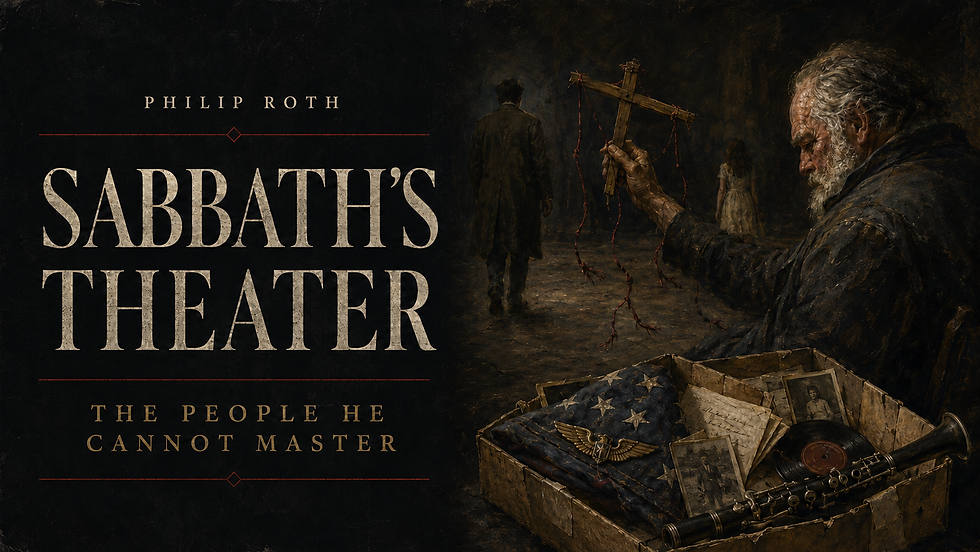
At Fish’s apartment, Mickey finds the carton his mother labeled “Morty’s Things.” He opens it on the beach, where bare labels begin breaking up his associations—a faded flag, an electric shaver, photographs, medals, a clarinet in five pieces. The items become more intimate as the sentences shorten. The shaver still contains particles of Morty’s beard. In the clarinet case lies its reed—“The reed from Morty’s lips.”
Mickey’s language usually converts what it touches into performance. The inventory keeps pointing back to matter. A reed that met Morty’s mouth has survived him without becoming eloquent, and its muteness gives Mickey nothing to mimic. The passage has moved restlessly among he, you, we, and I. When the decision arrives, the first person is suddenly plain. “I cannot walk into the waves and leave this stuff behind.” No audience is invoked and no opponent anticipated; his next action obeys the sentence as he drives the carton home for safekeeping.
By the time he reaches Roseanna’s house, he is “custodian of Morty’s things.” A puppeteer makes an object answer to his hand; a custodian answers for objects already charged by somebody else’s life. Morty’s belongings neither perform nor forgive. Their claim on him is practical, and he must carry them off the beach.
Within pages, Mickey is mocking Roseanna again and imagining how he might resume his old life. He later writes instructions for Morty’s things to be buried beside his naked body, trying to recruit the box into a final production. The box changes his conduct without changing the man.
The Last Puppet Refuses
The carton postpones Mickey’s suicide; soon he begins staging it again. He calls death the “finishing touch to the running gag” and imagines the puppeteer disappearing behind the screen to take the finale as the puppet. At Drenka’s grave he finds a possible director for that ending. Her son Matthew, now a state trooper, catches him there and condemns the desecration of his mother.
Mickey tries to turn Matthew’s rage into the weapon he needs. He begs to be shot while escaping, even supplies the lie that Matthew’s colleague could tell afterward. The imagined murder would spare Mickey from acting alone and make another person complete the design.
The attempt has been read as one last act of puppetry. Matthew sobs through his fury, removes the handcuffs, and leaves without firing. His refusal removes the climax Mickey had written for him.
Portnoy’s Complaint grants Spielvogel one sentence after hundreds of pages of Portnoy. He can comment on the performance only once it is over. Matthew acts while the outcome remains open, and his restraint keeps Mickey alive.
Abandoned in the woods, Mickey discovers that he “could not fucking die.” The pronoun preserves the narration’s fractional distance while the profanity carries his mouth into the sentence. Narrator and character occupy the same line without becoming the same voice.
The also that spoiled Nikki’s perfect performance has acquired its full cost. Matthew is a grieving son and a policeman, yet he is still also Matthew, free to refuse the part Mickey offers him. Nikki’s life beside her role deprived Mickey of artistic perfection. Matthew’s life beside his assigned role deprives him of a perfect death.
Mickey remains the same dangerous man, his appetite and ingenuity intact. Survival keeps him answerable to people he could never reduce to his theater. He once preferred puppets because they could not disappear. Roth leaves him alive in the custody of the disappeared, with Morty’s box still waiting in his car.
Sources and Further Reading
Philip Roth, Sabbath’s Theater (Vintage, 1996; first published 1995).
Garth Greenwell, “A Moral Education”, The Yale Review, March 20, 2023.
Frank Kermode, “Howl”, The New York Review of Books, November 16, 1995.
Daniel Ross Goodman, “The Uncontrollability of Real Things: Operation Shylock, Sabbath’s Theater, and Philip Roth’s Falstaffian Theology of Judaism”, Philip Roth Studies, Fall 2020.
Jonathan Yardley, “Second Childishness”, The Washington Post, August 26, 1995.


Comments