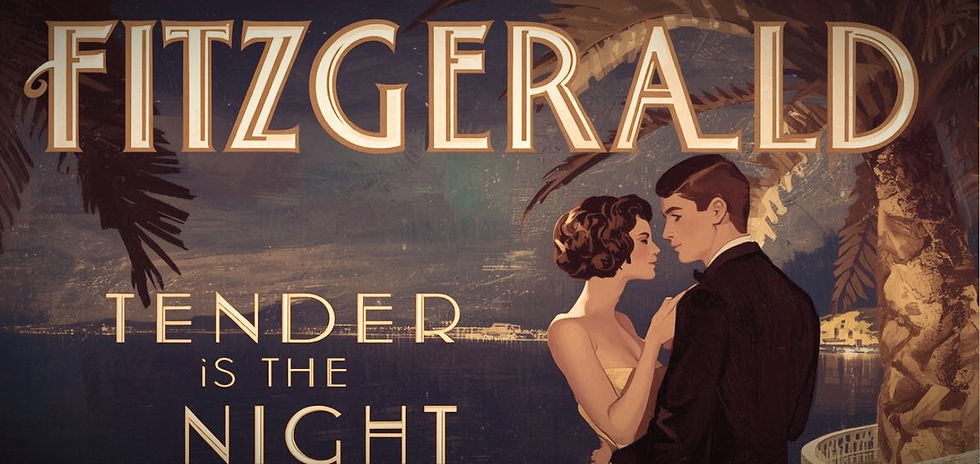
Tender Is the Night: Fitzgerald’s Riviera Tragedy

Updated: Apr 19
I finished rereading Tender is the Night last week, almost ninety years after its 1934 publication.
The book hit me harder this time than it ever has before.
Fitzgerald poured more of his own unraveling life into these pages than into anything else he wrote—his marriage to Zelda, his battles with alcohol, his slow slide from golden boy to burned-out case.
He worked on it for nine years, rewrote it repeatedly, and still felt it fell short of what he wanted.
Sales were modest, reviews mixed.
Six years later he was dead at forty-four, leaving behind a novel that many readers (myself included, now) consider his most mature and devastating work.
I like it more than The Great Gatsby.
There, I said it.
I give Tender is the Night a clear 4 out of 5 stars.
The glamour is still there, the sentences still sing, but the emotional stakes feel higher, the fall steeper, the portrait of human damage more unflinching.
The Story in Careful Outline (No Spoilers)
The novel opens on the French Riviera in the mid-1920s.
A young American actress, Rosemary Hoyt, arrives at a sun-drenched beach and falls under the spell of Dick and Nicole Diver—a dazzling expatriate couple who seem to embody everything sophisticated, charming, and alive.
Parties sparkle, conversations glitter, the Mediterranean light feels almost tangible.
The narrative then shifts perspective and time (a structural choice we’ll circle back to).
We gradually understand the cost of the Divers’ polished existence, the psychiatric history that binds them, and the slow erosion of Dick’s once-formidable gifts.
Fitzgerald tracks a marriage the way a doctor tracks a chronic illness: symptoms appear beautiful at first, then increasingly ominous.
Dick Diver: The Slow Unraveling of Charm
Dick Diver is one of the great tragic figures in American literature.
A brilliant psychiatrist, cultured, generous, effortlessly magnetic, he organizes life around making other people feel enhanced by his presence.
Early on, he seems almost superhuman in his capacity to give.
But that very generosity becomes his undoing.
He spends himself on others—patients, friends, his wife—until there’s little left for himself.
Reading him now, I think of Nietzsche’s warning about gazing too long into the abyss, except here the abyss gazes back by draining the gazer dry.
Fitzgerald refuses easy judgment. And that’s a strong perspective.
Dick’s decline is never reduced to simple alcoholism or moral weakness; it’s the gradual exhaustion of a man who tried to live as an ideal rather than a person.
(Remember that structural shift? It mirrors Dick’s own loss of control over his story.)
Nicole: From Patient to Survivor
Nicole Diver begins as an enigma—beautiful, fragile, dependent.
Her mental illness is rooted in trauma Fitzgerald draws from Zelda’s schizophrenia, though he transforms it into something both clinical and poetic.
What struck me on this reread is how subtly Fitzgerald charts her growing strength.
She is never just a victim or a muse; over the course of the novel she reassembles herself while Dick disassembles.
Their trajectories cross like ships passing, one rising as the other sinks.
In an era when mental health was barely spoken of, Fitzgerald treats Nicole with remarkable empathy.
He understands breakdown and recovery not as moral failures but as human processes—messy, uneven, sometimes irreversible.
The Riviera World and Its Supporting Players
The expatriate circle around the Divers feels vividly lived-in.
There’s Tommy Barban, the mercenary adventurer;
Baby Warren, Nicole’s coldly efficient sister;
Abe North, the talented composer drinking himself to death.
Each character reflects a different facet of post-war American displacement.
Fitzgerald captures the peculiar exhaustion of endless leisure.
These people have escaped the constraints of home, yet they carry their damage with them like expensive luggage.
The Riviera itself becomes a character—seductive, indifferent, ultimately corrosive.
Themes That Still Cut
Tender is the Night is, among other things, a novel about emotional labor in relationships.
Dick performs care the way Gatsby performed wealth, and both performances collapse under their own weight.
It’s also a prescient portrait of mental illness.
Fitzgerald read deeply in psychiatry (he consulted experts while writing) and renders Nicole’s episodes with chilling accuracy—dissociation, paranoia, the terrifying clarity that sometimes arrives in crisis.
And it’s a book about success as slow poison.
Dick achieves everything early—promising career, beautiful wife, international glamour—only to discover that arrival is the beginning of decline.
There’s a quiet horror in watching someone who once had the world’s possibilities gradually narrow to nothing.
The Prose and the Controversial Structure
Fitzgerald’s writing here is less fireworks, more sustained glow.
Sentences unfurl with a languor that matches the Riviera heat.
The imagery is tactile, almost synesthetic.
You feel the sun, smell the pine, taste the gin.
The original structure—beginning with Rosemary’s dazzled perspective, then rewinding to show how the Divers reached that point—divided readers.
Fitzgerald himself later rearranged it chronologically for a posthumous edition.
I prefer the 1934 version.
The delayed revelation creates a sense of inevitability, like watching a film in reverse and forward simultaneously.
Some passages drag, especially in Book Two’s Hollywood detours.
Yet even the longueurs feel intentional, mimicking the aimless drift of lives running out of purpose.
Why 4 Stars and Not 5? A Personal Note
This is Fitzgerald at his most adult, least sentimental. Compared to Gatsby’s crystalline perfection, Tender feels riskier, more uneven, more alive with contradiction.
But it isn’t flawless.
Certain secondary characters (the Hollywood crowd especially) feel sketched rather than inhabited.
The ending, while powerful, arrives with a quietness that can feel abrupt after so much emotional investment.
Still, the book moved me in ways Gatsby never quite has.
Dick’s decline resonates with anyone who has watched talent and vitality slowly leak away—whether in themselves or someone they love.
Nicole’s resilience offers a counterweight of hope, muted but real.
I kept thinking of Chekhov’s plays: the same sense of beautiful people talking brilliantly while their lives fall apart behind the words.
The Novel’s Quiet Afterlife
Unlike Gatsby, Tender is the Night never became a cultural juggernaut.
No blockbuster film (though there was a forgettable 1962 adaptation), no endless memes, no themed prom nights.
It remains Fitzgerald’s most literary novel—admired by writers, debated by scholars, loved by a smaller but devoted readership.
In 2026 it feels newly relevant.
We talk more openly about mental health now, about burnout, about the hidden costs of caretaking roles.
Dick and Nicole’s story speaks directly to those conversations.
Closing Reflections
Tender is the Night is the sound of a gifted writer confronting his own wreckage and still finding beauty in it.
Fitzgerald doesn’t offer redemption or tidy moral lessons; he offers understanding, which is rarer and harder.
I’ll return to it sooner than I return to Gatsby.
Not because it’s perfect, but because it feels truer to the way lives actually fray.
Rating: 4 / 5 stars
Related Articles on Fitzgerald and Classic Literature:


Comments