The Anatomy Lesson: When Words Come Too Easily

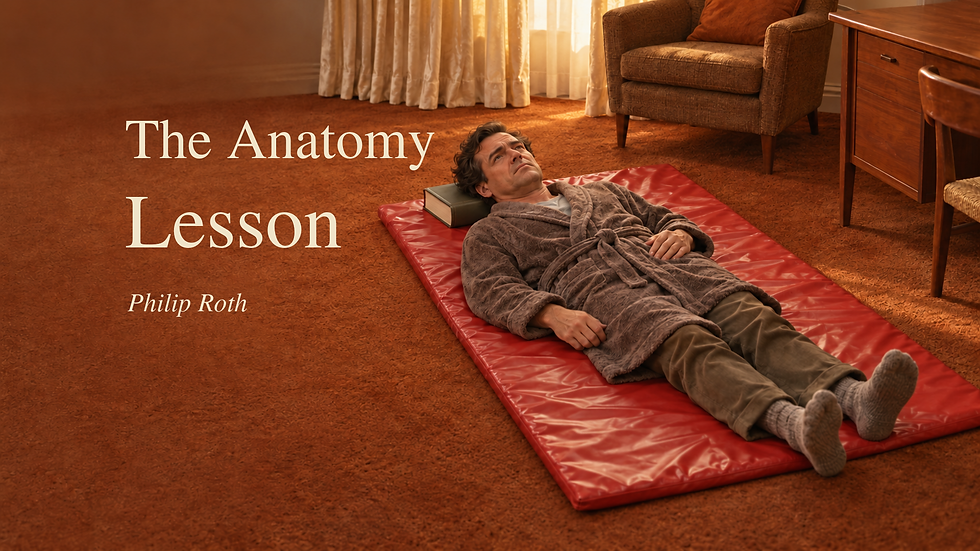
Roget’s Thesaurus props up Nathan Zuckerman’s head. He lies on a red children’s playmat in his study, using the book his father gave him when he finished grade school. “You have my every confidence,” the inscription says. In Philip Roth’s The Anatomy Lesson, the gift still serves a purpose: its thickness keeps Nathan’s head level with his shoulders, relieving the pain that has made writing almost impossible.
Roth makes the novelist’s working conditions painfully exact. A chair, a pen, even the angle of an arm can defeat him. Then, as Nathan begins imagining a new career in medicine, his speech gets to a point of an almost unlimited freedom. The change can be exhilarating, though I find the novel less compelling when that fluency carries us too far from the physical effort its opening makes us feel. Its force varies with the resistance Nathan’s words encounter.
This essay discusses the novel in full, including its ending.
Why Nathan cannot write
The opening exhausts ordinary actions. Buying groceries means carrying one light bag against the chest; frying an egg means enduring the time spent upright at the stove. Roth gives these small tasks the elaboration normally reserved for an expedition. The sentences keep adding conditions to actions that a healthy person scarcely notices doing.
That accumulation also defeats the familiar image of a writer needing peace and quiet. Nathan has soundproofing, comfortable furniture, money and time. Each improvement meets another practical obstruction. He changes typewriters, tries longhand, has a board fitted across a chair’s arms, then abandons the chair for the floor. We keep following the adjustments and every solution has to survive contact with his body.
Dictation ought to release him from these arrangements. He can imagine what a sentence describes, but he cannot compose without watching the words join on the page. Roth separates having something to say from making prose. The secretary may wait an hour for the next words. Even with the strain of holding a pen removed, he still needs the sight of a sentence to continue it.
Meanwhile, the novel’s narration runs through all these failures with remarkable ease. Its closeness to Nathan lets complaints, medical opinions and desperate counterarguments crowd together. There is no shortage of language. What has become scarce is the sustained physical and mental act that turns language into a finished page.
Starting over, in his mother’s handwriting
The recollection of his mother’s death slows the book without weakening it. In her apartment, Nathan searches the pockets of a raincoat. A tissue smells only of tissue. A neatly folded rain bonnet gives him a little of her habitual care; a chiffon hood briefly frightens him because he mistakes it for underwear and imagines an unnoticed symptom of her illness. The objects keep correcting his guesses as he handles them.
Roth makes us wait through these small investigations. Nathan wants some trace of a person who will no longer answer him, and each thing he finds offers a different, incomplete kind of contact. Even his tears become suspect to him: perhaps watering her plants and listening to her music amount to a scene he has arranged for himself. The novelist cannot easily suspend his scrutiny of a performance, including his own grief.
Among her possessions is a baby-care book with his development recorded in her handwriting: his weight, the day he held up his head, his first word and teeth. These entries measure a life through capacities acquired. We encounter them after watching the adult Nathan struggle to hold up his head.
The short notes also recall a use for writing that his literary crisis can obscure. His mother was keeping track of someone she had to feed, dress and help grow. The record has survived the person who made it; Nathan can follow her attention from one small bodily achievement to the next.
Already accepted, in a sentence
In medicine, Nathan hopes to give such attention a practical purpose. After so many inconclusive consultations, he wants to become the doctor who stays with a patient’s suffering. The ambition has enough generosity in it to make his impatience interesting. We can understand the appeal of being useful even as we watch him hurry past the work it would require.
The arrival of a medical-school catalogue gives Roth an opportunity to put that hurry on the page. A paragraph of admissions policy explains that age, among other things, has no bearing on an application. For Nathan, the absence of an age barrier becomes a promise of admission: “They didn’t care that he was forty. He was in.”
For a moment, the institution’s language seems to have opened a door. Turning back a page restores the science prerequisites, and Nathan has to reckon with a year’s work before medical school can even begin. But the anticipated years of study and residency pass rapidly through his thoughts. He reaches forty-eight, ready for practice, and deals with the question of his health by imagining that the change of profession will cure him. Failing that, he will cure himself. The ease of the sequence belongs to the man arranging it in his head.
Later, speaking to Bobby Freytag, his former college roommate and now an anesthesiologist, Nathan praises the certainty he thinks medicine offers. “A leads to B and B leads to C.” He asks whether he is idealizing the work, then tells Bobby he need not answer, withdrawing the invitation to correct him almost as soon as he offers it.
Percodan has helped set him talking. Roth places Nathan’s declaration that he is well after a list of the pills, marijuana and vodka he has taken, so that his exhilaration reaches us with its bodily conditions still in view.
How long can Milton Appel keep talking?
The journey to Chicago gives that fluency another outlet. On the plane, Nathan begins impersonating a pornographic publisher, borrowing the name of Milton Appel, a critic who has attacked his work. The invention lets him go beyond a defense of his own books. He can invent an entire business, a sexual philosophy, a family and a public reputation, then speak with the indignation of a man whose contribution to America remains unappreciated.
There is more going on here than an abusive portrait of an enemy. The imaginary publisher has a son called Nathan. As the performance develops, Zuckerman becomes a father explaining himself, wondering what to tell his child and insisting on the sincerity of his love. He has furnished the man with reasons to feel misunderstood. His own preoccupations keep finding new positions inside the story he is making up.
With Ricky, the chauffeur he has hired, Nathan keeps bringing pornography back to freedom, money and the hypocrisy of respectable employment. She explains her refusal to work for him in New York: “I work for myself.” His response repeats the accusation he made before she answered: “Because you are a God damn feminist.”
The routine begins to wear on me when Nathan resumes it the following day. Nathan has already wondered whether his invention offers much wisdom beyond the familiar claim that a madam is more moral than her critics. He means to stop. Then he finds the car waiting and begins again. Roth has supplied a reason for the excess: Nathan enjoys the person he can become by talking. I begin to anticipate how he will turn resistance into more material, and the length of the speech becomes easier to notice than its discoveries.
Ricky’s objection is apt asit concerns the occasion as well as the argument. The partition in the car exists for her too. She wants to drive, retain her independence and keep her private life. Nathan’s invented publisher can claim to liberate people while refusing the ordinary separation she asks for.
The body finally interrupts with less regard for argument. Another Percodan brings a stupor in which Nathan struggles to retain a question long enough to answer it. The writer who needed to see words fastening together can no longer hold his thoughts together.
Learning to speak again
After attacking Bobby’s bereaved father at a cemetery, Nathan falls and badly injures his mouth. In the hospital, Bobby tells him not to try speaking. He puts a marker in Nathan’s hand and asks him to write down the diagnosis of the pain he had before the fall.
“He wrote a word: none.”
This is writing Nathan can manage. It gives Bobby the information he needs, including the fact that so much suffering has produced no agreed explanation. To answer Bobby, he need not account for his career, defend his books or prove that his pain has a meaning. Beside the long, brilliantly equipped speeches, its smallness is startling.
The recovery from the mouth injury takes the novel back to elementary acts. Nathan has to learn to form simple words with his lips, palate, tongue and teeth. Roth specifies that he is doing this for the second time in forty years. The baby-care book recorded the first word and teeth, the ability to hold his head up; now speech requires the attention to bodily parts that a fluent adult can usually forget. Those early entries have an unexpected continuation.
These are words Nathan has spoken all his life. They feel new because he must work to pronounce them. The prose can convey that pleasure without requiring us to believe that the injury has supplied a cure for his earlier pain, or that he has become a different man.
He remains interested in medical school. During his hospital wanderings, encounters with patients provoke fresh plans for specialties he might pursue. The work draws him, and Roth lets the attraction survive his physical revulsion at what some of it involves. But the last sentence keeps him a patient following the interns, “as though he still believed” that he could escape “the corpus that was his.” The word holds his body and his books together, even in his hope of leaving them behind.
I am less persuaded by the long stretches in which Nathan’s ability to keep talking must supply most of the movement. Roth’s attention to the making and remaking of words feels more exact. A young secretary waits for a sentence that will not come; a doctor waits for an answer his patient cannot say aloud. Nathan can give the second of them something useful. It takes one word, written on the pad beside his bed.
Sources
Philip Roth, The Anatomy Lesson (1983).


Comments