The Best Way Into Roberto Bolaño: A Reading Map for Beginners

Updated: Sep 1
The worst way to start Roberto Bolaño is to treat him like a monument.
Readers who approach him this way get trapped immediately. They hear the name through 2666, or through the mythology of The Savage Detectives, or through the aura around the dead Chilean novelist who became one of the international literary events of the early twenty-first century. They assume the correct entrance must be the biggest book — the one everyone mentions when they want to prove Bolaño matters.
Then they open the door and find five doors behind it.
Bolaño doesn’t behave like a normal major novelist. His world is made of missing poets and failed movements and fascist shadows, of detectives who are not detectives and artists whose art becomes evidence — young people chasing literature until literature stops looking like salvation. The books connect, echo, mutate, contradict one another. They are not a staircase. They are a set of rooms with the same bad weather moving through them.
It is the entrance that matters most, not the book. What you want is the first room that lets you breathe Bolaño’s air without drowning in it.
For most readers, the answer is Distant Star.
Start with Distant Star: Bolaño in Miniature

Distant Star is the cleanest blade.
It is short, cold, and almost impossibly concentrated. You can finish it before the mythology of Bolaño has time to intimidate you. The book gives you the essential materials at once: poetry under dictatorship, aesthetic seduction in proximity to violence, and the horrible possibility that art can become a way of arranging cruelty rather than resisting it.
The premise is simple enough to follow. A mysterious poet-pilot appears in the Chilean literary world during the years of political violence. He writes poems in the sky. He may also be a murderer. Around him, Bolaño builds one of his central questions: what happens when the world of letters, instead of protecting the human being, becomes fascinated by the elegance of danger?
Distant Star doesn’t explain Bolaño. It exposes the nerve — which is exactly what an entry point should do.
You meet his distance before you meet his sprawl. You learn that his narrators often speak as if reporting from after the disaster, not before it. His violence rarely arrives as a clean spectacle — it is glimpsed, delayed, passed from witness to witness until the reader begins to feel the moral coldness of the archive.
A larger book would bury this effect inside abundance. Distant Star leaves it bare.
Move to By Night in Chile: The Confession That Cannot Wash Itself Clean
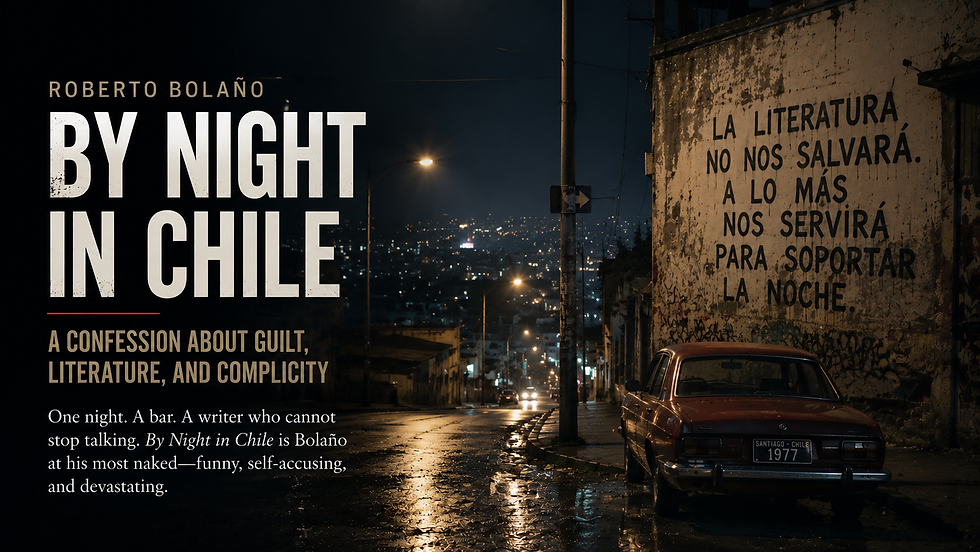
Once Distant Star has shown you Bolaño’s blade, By Night in Chile gives you the voice.
The book is almost one long confession. A dying priest, critic, and literary man speaks through the night, trying to defend himself, remember himself, purify himself, or at least arrange the evidence in a form that will not condemn him too completely. The sentence moves like a mind that cannot stop speaking because silence would be worse.
Bolaño’s deepest territory is cultivated guilt — the idea that education, refinement, and salon culture can arrange a defense after the fact without changing what the fact was.
By Night in Chile is not difficult because the plot is hard to understand. It is difficult because the narrator’s refinement is part of the danger. He is educated. Poetry is among his accomplishments. He moves among writers and patrons and officers, in salons that smell of money and books — and he wants culture to save him from what culture has already served.
Literature is not innocent just because it is literature. A room full of readers can still be a room next to violence — and a beautiful sentence can still be a hiding place.
Reading By Night in Chile after Distant Star gives the first book a second chamber. The sky-writing poet showed art crossing into horror. The priest-critic shows respectability arranging a defense after the horror has already happened. One book is the blade. The other is the polished handle.
The Short Stories Are Weather, Not Homework
After the two short novels, go into the stories.
In the stories, his world loosens its collar. The exile rooms, the wandering writers, the sudden abyss behind a casual anecdote — these are the materials of his atmosphere.
The stories teach something the novels sometimes conceal through scale. Bolaño is not only a novelist of horror and politics and authorial myth-making. He is also a master of drift. Someone remembers a poet who never quite happened. A city appears for a few pages, vanishes, and turns out to have been someone’s whole youth. A writer survives one country and arrives in another already carrying the wrong kind of knowledge.
The best stories feel like postcards from a life that never became stable enough to become a life.
Read Last Evenings on Earth. Take them slowly enough that they open rather than instruct. They aren’t preparation for the real books. They are the climate those books require.
Where 2666 Belongs
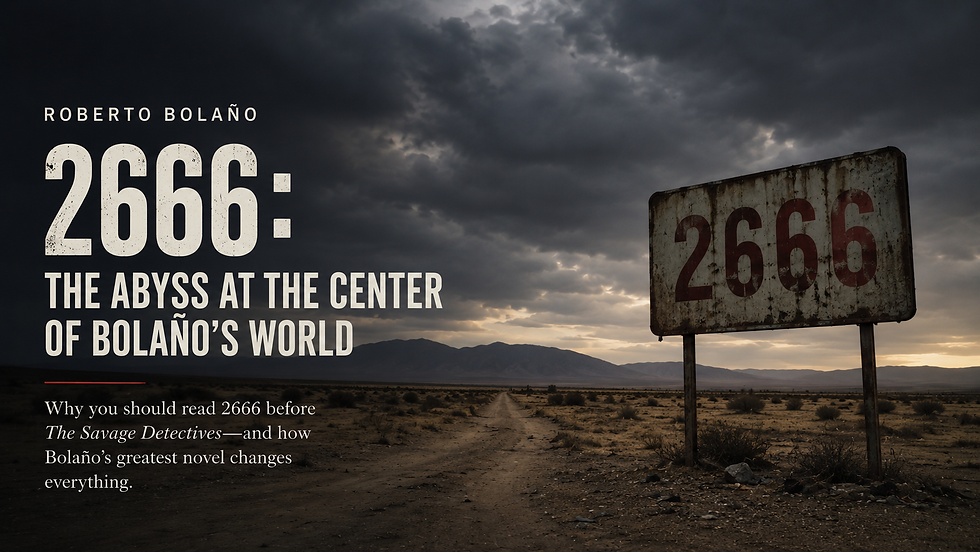
Many readers ask whether 2666 should be saved for last.
Usually, that would be sensible. It is huge, unfinished, divided into five parts, and built around one of the darkest centers in modern fiction. Even so, in this reading map, 2666 comes before The Savage Detectives.
The reason is emotional, not only practical. 2666 is the descent. The Savage Detectives is the return.
By the time you reach 2666, the earlier books have done their work. Distant Star has prepared you for art under the sign of violence. By Night in Chile has shown how culture arranges its own defenses. The stories have taught you that wandering lives can be caught in systems larger than themselves. You’re not ready for 2666 in the sense that anyone is ready for it. You’re ready enough to recognize its weather.
The book opens room after room until the reader loses the comfort of a single center. Critics and writers, a desert and a city, murders accumulating into an archive of unspeakable size: 2666 doesn’t move like a normal novel because its subject can’t be held by a normal novel. The scale is part of the wound. It keeps widening because the wound keeps widening. What began as one man’s notebook habit became, against the author’s will, the twentieth century’s bookkeeping of its own murders.
Starting there is like entering a country through its mass grave. The power is real, but orientation comes too late.
Read it when you already trust Bolaño’s method. The apparent detours are where the horror gathers its force — you’ll need to know this before the long sections begin asking you to wait. And accept, before opening it, that some books are not built to resolve the world. They’re built to show the size of what cannot be resolved.
Then, strangely, go back to youth.
End with The Savage Detectives

The Savage Detectives is the book many readers expect to begin with.
It has young poets and Mexico City, rebellion and sexual energy, the myth of a vanished avant-garde looked at from the wrong side of survival. It is the great book of Bolaño’s youth among writers, even when it knows perfectly well that youth is already being mythologized by those who survived it badly.
Yes, it can work as a first Bolaño novel. Yes, many readers have entered through it and stayed. Yes, the energy of Mexico City carries even a beginner. As a final book in this particular path, though, the novel becomes richer.
After 2666, The Savage Detectives no longer feels only like a wild adventure among writers. It becomes the dream before the ruin — or the memory of the dream after the ruin has already become visible. The jokes darken. The poets begin to look younger and more ridiculous and more doomed, in the way old photographs of the dead always do. Their hunger for literature becomes both touching and dangerous because you now know where some forms of literary hunger can lead.
The Savage Detectives is not smaller than 2666 because it is younger in spirit. It is simply organized by a different kind of loss. 2666 looks at the world when the wound has become almost planetary. The Savage Detectives looks at the moment just before — when young people still believe the right poem or the right journey might save them from ordinary life.
Bolaño knows better. He loves them anyway.
What About the Poetry?
Bolaño thought of himself as a poet before he thought of himself as a novelist. Any honest reading map has to say this.
Still, the poetry isn’t the best entrance for most readers. It opens better after the fiction has done its work — once the figures and tones and self-mythologies have become familiar. The poems matter as part of the Bolaño system. They help explain the life he imagined for literature and the kind of writer he wanted to be.
I’ve written elsewhere on the site about Bolaño’s poetry and the strange fact that his greatest poetry may live more intensely inside the novels than inside the poems themselves. For this beginner’s path, the practical advice is simple: do not begin with the poems. Let them become a side chamber after the main rooms have opened.
Bolaño’s own belief in poetry — that the poem was the truest form of literature, the one a writer carried before everything else — was probably foolish. It was also the fire he never entirely put out.


Comments