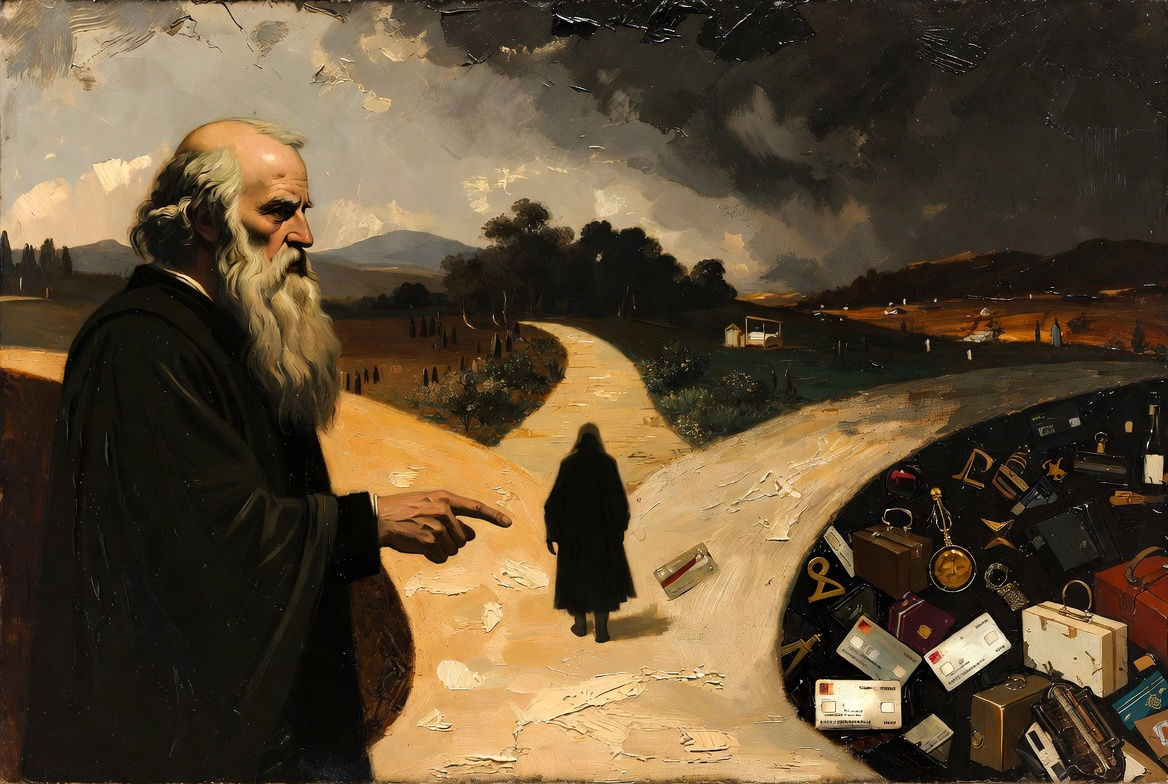
The Garden in the Machine: Epicurus and the Ghost of Modern Want
- David Lapadat | Music PhD

- Apr 23
- 8 min read
In a checkout queue, a delay of three minutes now feels long enough to provoke a reach for the phone. The hand moves almost before the mind does, seeking some small neurochemical distraction to blunt the tiny wound of waiting.
Look at the cart while the hand is occupied. Half of what is in it was not on any list. A jar whose label promised something artisanal. A snack chosen from a mood that passed through the aisle at the wrong moment, rather than from hunger. A product on its second purchase, already familiar enough to read as a requirement though it entered the household less than a year ago.
The cart is a confession. Not of greed — greed would be more dramatic and therefore easier to identify — but of a quieter condition: the slow, ambient expansion of what feels necessary.
Civilisations of astonishing material abundance have made their inhabitants strangely fragile. Contentment now rests on a lattice of signals, subscriptions, conveniences, and small luxuries so dense that the failure of a single thread — a declined card, a broken device, a café that has run out of the right milk — can discolour an entire morning.
Epicurus, with a bag of barley, a pot of cheese, and a circle of friends, achieved a stability of spirit that no diversified portfolio has ever replicated.
Epicurus' Last Letter: The Most Radical Financial Document Ever Written
There is an episode in his life that feels less like philosophy than like the final page of a war novel. He is dying — slowly and in total pain — of kidney stones, an affliction which, in the third century BCE, offered nothing beyond endurance. The body fails. And yet the letter he writes in those last hours to his friend Idomeneus contains no bitterness, no theatrical defiance. Epicurus was not bargaining with fate.
He calls the day a happy one. He remembers his life in the Garden, a delight in simplicity that is almost promiscuous, then hands his thoughts to posterity as a receipt for a life addicted to real pleasure.
We can see the letter in a stoic tonality, or, in a cautious matter, and at a more profound level, we can foresee one of the most radical financial document in the Western tradition.
What was written there does not advise, it doesn’t even demonstrate. It arrives more like a revelation, along with a man in agony, with nothing left to protect, a man which discovers that what mattered was never at risk — because what mattered was never the kind of thing that could be taken.
The conversations, the friendships, the quality of attention brought to an ordinary afternoon — the particular way light entered the Garden at a certain hour, the taste of bread eaten in company that required neither ceremony nor apology — these had been the wealth all along, and they had been available at a cost so low that a modern accountant would have rounded it to zero.
Some cheese and little barley were enough because the life they supported was already full.
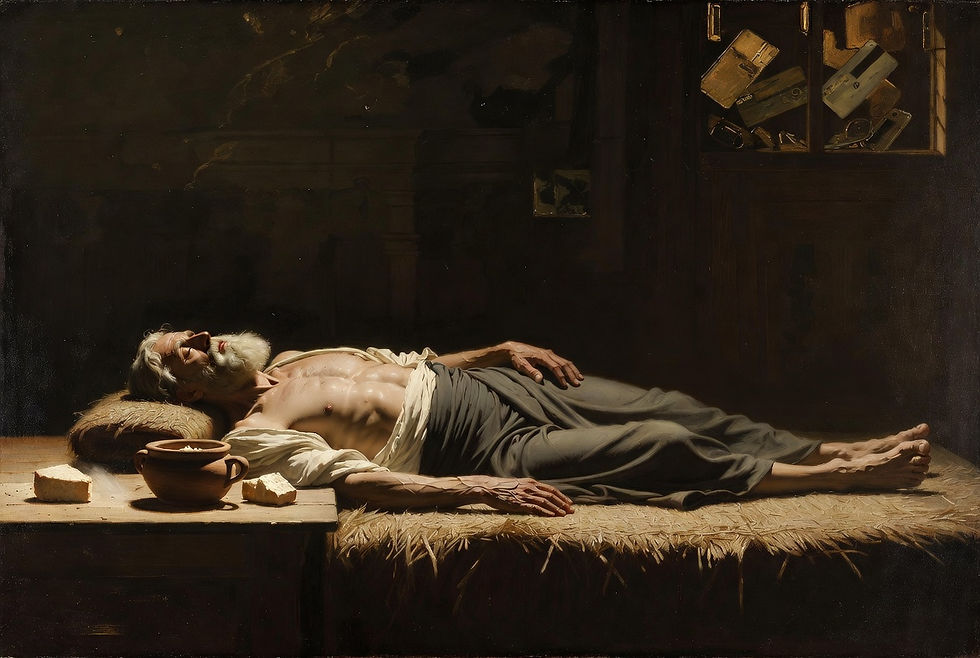
Epicurus taught before he died. His taxonomy of desires is deceptively simple, the kind of distinction that appears so obvious until one tries to apply it honestly to a real budget.
Some desires are natural and necessary: food when hungry, water when thirsty, shelter from cold, bodily safety, the company of those who know you well enough to speak plainly.
These are wants whose satisfaction removes genuine pain.
Some desires are natural but unnecessary: finer food, softer bedding, better wine, a room with more light. These are real pleasures, but they do not enlarge the total structure of wellbeing. They colour a life that is already sound.
Another kind of desires start taking shape in a most dangerous manner. A class of desires neither natural nor necessary, such as fame, prestige, status competition, wealth accumulated for display or symbolic reassurance rather than for use.
These, Epicurus says, arise from groundless opinion, and they possess the fatal quality of having no natural limit.
We sense the clarity of this taxonomy, and that is where the force of the distinction lies — in its precision. Epicurus is not praising poverty for its own sake, but he is trying (and succeeding) to separate structural necessity from ornamental escalation, as a good engineer removes unnecessary material from a bridge, because the structure must (and can) reliably bear what it must.
Every superfluous desire attached to happiness adds another stress point. These add until we become a nucleus of stress points coated by empty convenience. As for the self in relation to others, a particular stream of social confirmation needed solely to feel normal already built a lattice of conditional contentment.
And every new condition is another place where failure can enter.
Epicurus‘ Vision: Why More Stops Feeling Like More
Modern consumer life teaches people to imagine pleasure as a slope that rises with every upgrade. Epicurus saw something closer to a plateau.
Once the pain of deprivation has been removed — once a person is fed, sheltered, rested, and among trustworthy people — pleasure does not continue to climb in proportion to expense. It merely changes texture.
Bread and cheese bring a hungry person to satiety. A banquet can do the same. The banquet may be more elaborate, more memorable, even more beautiful, but it does not create a second order of satiety — it is a costlier road to an already available destination.
Suppose the mathematical error at the centre of much modern spending is simple. We pay staggering premiums for variations that do not alter the sum. A seven-euro latte does not make a person seven times more alive than the coffee brewed at home. The annual device upgrade often solves no meaningful problem; it soothes an irritation manufactured by a product cycle.
What reads as ascent is often a more expensive method of returning to the same baseline — perpetual surcharges for the illusion that the curve is still rising long after it has flattened.
In Hunger, Hamsun’s half-starved narrator periodically spends what little he has on gestures that make no practical sense — a gift to a stranger, a coin thrown away, a purchase whose uselessness is part of the point. The expenditure is existential. To buy the useless object is to feel, for a brief instant, like the kind of person to whom deprivation does not apply. Spending often serves the same drama at a higher income level. A scarf, a watch, a better hotel room — these may be less about utility than about purchasing a temporary suspension from some private wound.
A single vine, left unpruned, does more than grow — it colonises. It wraps itself around neighboring stems, draws off light and water, and slowly converts a balanced ecosystem into a monoculture of its own ambition.
Life organized around escalating pleasures follows the same logic. Every new “necessary” luxury sends tendrils into income, time, expectation, and self-concept. Eventually the simpler satisfactions that once sustained the person are shaded out. One has stopped cultivating a life. One is feeding a single appetite that has mistaken its own overgrowth for flourishing.
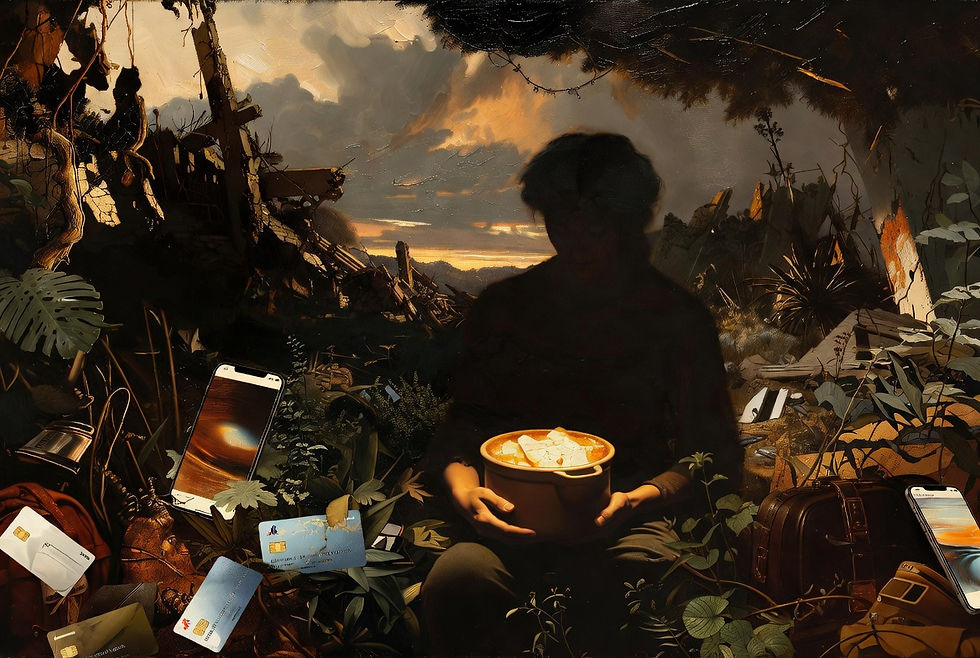
What the Bank Statement Really Confesses
A budget is autobiography in a sense. It possesses a language harder to falsify than speech.
People can narrate almost any version of themselves they like, but six months of spending will reveal a person's private theology with a precision that would make a psychoanalyst envious.
The late-night delivery orders clustering around Sunday evenings may be less about hunger than about dread of the coming week. “Comfort food” mirrors a fallacy.
Monuments of our abandoned aspirations, peculiar forms of self-medication, that’s what we often carried out with our card.
“The wealth required by nature is limited and is easy to procure; but the wealth required by vain ideals extends to infinity.”
This is how Epicurus describes the dangerous desires as empty. They promise solidity while resting on nothing firm.
Status, admiration, symbolic proof, the costume of a life capable of impressing strangers — these are not immoral desires so much as bottomless ones. A person can pour an entire career into them and never hear the sound of anything landing.
Every city develops its uniforms. In one place, taste is signalled through studied casualness; in another, through visible scarcity, invisible logos, or the correct species of artisanal consumption.
Wherever human beings gather densely enough to observe one another, spending turns theatrical.
Luigi Pirandello built a great deal of his work on the devastating fact that masks eventually adhere to the face.
We begin by choosing a role and gradually lose the ability to distinguish the role from the self. The expensive coffee, at first a pleasure, hardens into a signal. The jacket, once a garment, drifts into social language. The holiday, chosen as rest, turns into evidence.
Soon the purchase is being made for the identity it allows a person to inhabit in public.

The Pot of Cheese and Epicurean Architecture of Enough
What emerges from honest examination is a baseline — and the question beneath the baseline is plain: what do you actually need?
The level below which real discomfort begins, and above which much spending reveals itself as optional decoration.
Most people find out that this baseline is lower than they had imagined and more stable than modern life encouraged them to believe.
Small pleasures regain force when they stop being administered continuously. A treat recovers its character as a treat. Dependency loosens. Pleasure has not been destroyed, only kept from hardening into infrastructure.
E. F. Schumacher, writing in the twentieth century, imagined an economics ordered around the greatest wellbeing derived from the least necessary input, rather than around maximum consumption.
The Epicurean kinship is obvious.
Financial composure, on this view, does not begin with earning more. It begins when one has ceased to require an endless stream of additions in order to feel intact.
When contentment rests on low, durable, renewable goods, a person grows harder to terrify. Economic shocks are not something to dismiss, but they do not strike an interior arranged entirely around escalation.
Epicurus' letter about preserved cheese feels so profound because in a few words it defines wealth as the ratio between what one has and what one requires, rather than as accumulation. The person whose idea of a feast is a pot of cheese is difficult to impoverish.
He has set the threshold of delight low enough that satisfaction remains continuously available.
This is what modern marketing must conceal at all costs: the most intense pleasures in life are often the least expensive ones.
Water after labour; warmth in cold weather; a body at rest; a meal shared without audience; a conversation in which one is honestly understood. These are not consolation prizes for those who cannot afford better — they are the centre of the human estate.
Everything else is garnish that has been priced as if it were the meal.
A seven-euro latte is not the enemy, it can be a friendly companion as long as we discard the groundless opinion that the latte is what makes the morning good.
The morning is good because one is alive, because the body is at peace enough to feel, because consciousness still possesses the astonishing power of attention.
Once that settles as a lived truth rather than a poster, the seven euros can remain in the pocket from a quieter recognition that life-energy is worth more than a paper cup and a brief chemical consolation, rather than from grim self-denial.
Epicurus leaves us beside the empty pot of cheese and the glass of water, with an unwelcome clarity. If the subscriptions lapsed, the costumes were returned, and every secondary luxury went dark, many people would lose more than convenience — they would lose the machinery that keeps them from feeling their own lives. In that case, spending has ceased to purchase pleasure — it is purchasing delay. And the strange economy is that the more we buy to avoid the feeling of life, the more life recedes behind the purchase.


Comments