
THE GRAMMAR OF RUIN: How Financial Language Becomes a Prison — and Why You Keep Living Inside It
- David Lapadat | Music PhD

- 5 hours ago
- 8 min read
In the abyssal deep, the female anglerfish hunts with a bioluminescent lure suspended above her mouth. The light does not overpower its prey. In an environment stripped of ordinary bearings — no sun, no shore, no reference point the eye can trust — even a poor signal can become irresistible. The fish that approaches is not foolish. It is responding to the only thing that looks like guidance. The lure works because darkness has already done most of the work. What glows need not be true. It only needs to be the brightest thing in the field.
Modern financial life is not defined by a lack of information. It is defined by an overload so chaotic that it often produces the same practical effect: disorientation. In that darkness, specialized language glows. Passive income. Financial freedom. Alpha. Rebalancing. The terms arrive with the confidence of things that know exactly what they mean. They promise orientation, competence, admission to the right rooms. Under the pressure of Ludwig Wittgenstein's later philosophy, many of these phrases begin to look less like clean descriptions of reality than like moves in a game whose rules most players have absorbed without ever examining.
Wittgenstein spent the second half of his career undoing the intellectual architecture that had made him famous. In the Tractatus, his early masterpiece, he had tried to show how language could map the world with logical precision. By the time he returned to Cambridge in 1929 after years teaching in rural Austria, he no longer trusted that picture. What mattered, he increasingly thought, was not a word's hidden essence but the way it functioned in ordinary use. The meaning of a word is its use in the language. Meaning was not cargo carried intact from one mind to another. It lived in practice, custom, context, repetition — and it could mislead as fluently as it could clarify.
When Glow Starts Looking Like Truth
A command, a prayer, a joke, a promise, a diagnosis, and a flirtation may all use familiar words while doing entirely different things. No dictionary entry captures the full force of those acts apart from the social situation in which they occur. A term gets its life from the form of life around it. It means something because people know how to answer it, fear it, invoke it, obey it, or build institutions around it.
That shift matters in finance because jargon is not dangerous merely when it is technical. Many fields need technical language. Danger begins when a term borrows the prestige of precision while concealing the activity actually being performed. A word then stops clarifying reality and starts managing the social atmosphere around it. It tells the listener not only what to think, but how embarrassed he should feel for not already knowing.

Consider accredited investor. In U.S. securities law, the label opens the door to offerings unavailable to the general public. Qualification commonly turns on wealth or income thresholds rather than on any direct test of financial literacy or judgment. The word accredited sounds as though a person has been examined and found competent, yet in ordinary conversation it smuggles status under the cover of expertise. The designation does real legal work. But the everyday aura surrounding it exceeds the thing it names. The gate does not simply sort. The language blesses the sorting and makes it sound epistemic rather than economic.
This is the first private damage such terms can do. They make social fluency feel like understanding. A person can learn when to say the phrase, where to nod, how to borrow the cadence, and still remain vague about what is actually being named. The language works publicly long before it becomes inwardly clear.
Piranesi's Prisons and the Architecture of Passive Income
Much financial speech feels simultaneously specific and empty for exactly this reason. Take the phrase passive income. Its force depends on the fact that it promises two incompatible goods at once: money and relief from effort. Yet much of what falls under the phrase either requires substantial labor at the front end and recurring labor afterward, or else depends on someone else's labor while the owner's role is reduced to having capital in the first place. The phrase survives not because the contradiction is invisible, but because the contradiction is convenient. It lets a person speak of income while muting the questions of labor, risk, dependence, leverage, maintenance, and luck that give income its actual shape.
Piranesi's Carceri d'Invenzione remains the best image for this architecture. His prisons are enormous interiors of stairs, arches, pulleys, chains, and platforms that appear purposeful until one looks closely and sees that the staircases lead nowhere stable. The eye keeps moving because the structure keeps implying destination. Passive-income discourse works in much the same way. There is the research phase, with spreadsheets, forum threads, projected yields, and percentages carried to two decimal places. There is the selection, which often borrows the platform's own language to narrate why the choice is sensible. Then comes the small liturgy of execution: amount, date, account, confirm. A graph appears. The person feels, for a moment, not richer exactly, but more ordered.

What tends to disappear from that order is the ugly language that would interrupt the ceremony. You may lose some or all of your investment. Past performance is not indicative of future results. These sentences are not hidden. They are simply incompatible with the mood the ritual is designed to create. They sound coarse beside diversified income streams and compounding returns. They reintroduce contingency into a script that exists to make contingency feel managed. The investor who glides past them is not necessarily irrational. He is often doing something more ordinary and more dangerous: protecting the narrative atmosphere in which the action felt meaningful.
A related pattern appears whenever a platform turns verbs into nouns and then presents the nouns as possessions. Yield. Exposure. Upside. Downside protection. Each term can be useful in the right setting. Each can also remove the investor from the lived sentence underneath it. Instead of saying, I am taking a risk I do not fully understand because I am afraid ordinary saving will not be enough, a person can say, I want a bit more yield. The second sentence sounds calmer, and it hides more.
The Use of a Financial Word
Wittgenstein's great unsettling insight is that language-games are communal. They are not usually imposed by a villain standing outside the system. They endure because people keep participating in them. Platforms, advisors, marketers, and institutions all benefit from speech that sounds more exact than it is. But the trap would not hold if ordinary speakers did not also find something reassuring in the trap.
That reassurance often appears in public long before it is felt in private. A term enters the conversation — risk parity, perhaps, or even something as ordinary as rebalancing. There is a small pause. The face stays composed. The head nods once. Nobody asks what it means. What gets protected in that instant is not understanding but the appearance of being the kind of person for whom no explanation is needed.
Five plain words would break the spell: I don't know what that means.
Money is especially vulnerable to this performance because financial adulthood is so often confused with verbal fluency. In love, grief, illness, or death, people sometimes still admit bewilderment. In money, bewilderment feels discrediting. To confess opacity about a term can feel like confessing failure in life-management itself. So people speak the language first and hope understanding will follow. Sometimes it does, but more often what accumulates is a style of self-presentation in which knowledge is replaced by cadence, by the ability to sound already initiated.
What does financial freedom actually mean when the phrase guides your life before you have defined it? As a rough shorthand it points toward a recognizable aspiration: having enough assets or cash flow to live without depending on a wage. But as rhetoric it does something larger. It ends inquiry. Say financial freedom in a room full of adults and almost nobody asks for elaboration. The term carries such emotional authority that it passes for a plan the moment it is spoken.
Yet the closer one presses, the softer it becomes. Freedom from what, exactly? Only from a particular job? From all forms of paid work? From bosses, schedules, institutions, colleagues, expectations? Freedom for what? Leisure, travel, choice, stillness, status? And by what structure is this freedom maintained — a portfolio whose stability depends on markets the individual does not control, rates he does not set, political conditions he did not choose, and a body that will age whether the Monte Carlo simulation approves or not?
Most people who use the phrase do not mean nothing by it. They usually mean several serious things at once: margin, dignity, time, the ability to refuse humiliation, the hope of not being owned by the next emergency. But precisely because those desires are serious, they are poorly served by a slogan. The slogan blurs their differences. Margin is not the same as status. A reduced workweek is not the same as permanent retirement. The ability to leave a toxic employer is not the same as the fantasy of becoming structurally independent of every obligation. One phrase gathers all these wishes into a shining bundle and then asks the hearer not to separate them.
In Wittgensteinian terms, financial freedom often functions less as a destination than as a move in a language-game — one that organizes present sacrifice by naming a future condition whose felt texture remains almost entirely undescribed, a placeholder where a life plan should be, two words performing the work that should have required sentences, and a person who arranges his entire financial life around that undefined abstraction may discover, after years of discipline, that he has built not freedom but vacancy, having escaped one structure only to arrive inside another whose meaning was never articulated because the slogan kept standing in for thought.
Ruin Begins in Grammar
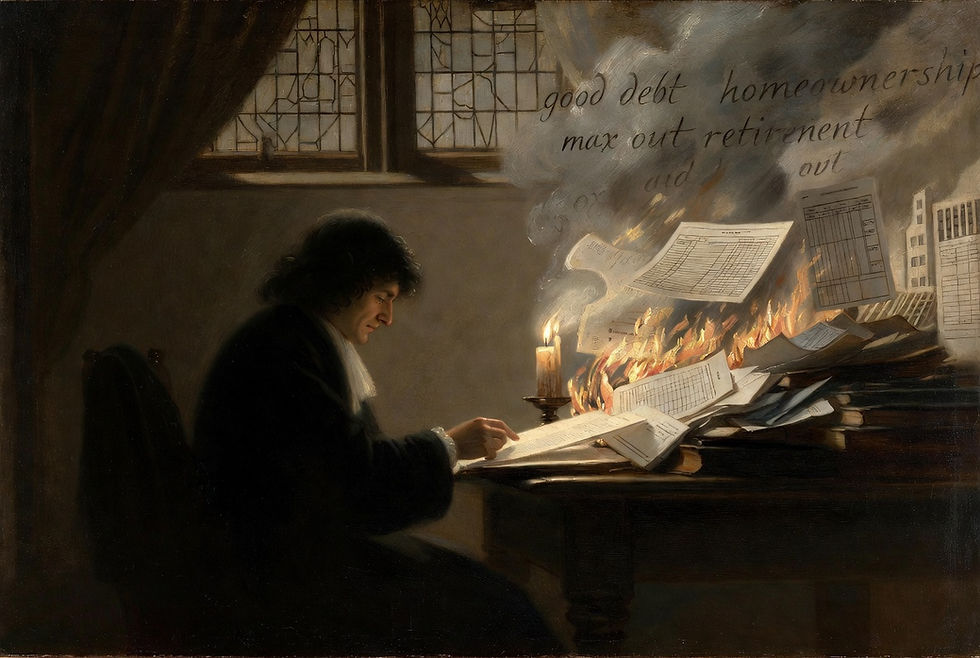
Wittgenstein understood philosophy less as system-building than as therapy. The task was not to produce one more grand explanatory scheme, but to loosen the knots words tie in thought. Applied to personal finance, that therapeutic impulse suggests a severe exercise: translate the financial terms you actually use into plain language that a bright twelve-year-old could understand without further explanation. DCA becomes sending money on a schedule. Rebalancing becomes moving money back toward the mix you wanted before it drifted. Passive income becomes money coming in from something that still carries risk, setup, ownership, or someone else's work.
Then comes the important part: notice where the translation stalls. The stalled terms matter most. They are often the load-bearing walls of the structure. They mark the places where borrowed vocabulary is carrying more psychic weight than personal understanding can bear. Where plain speech fails, something other than explanation is usually happening. Identity may be happening. Aspiration may be happening. Shame may be happening. The term has ceased to be a tool and become a shelter.

A financial plan does not finally live in a dashboard, and it does not finally live in a slogan. It lives in a sentence. Not an impressive sentence. Not a sentence borrowed from a platform, a forum, or an advisor's deck. A plain sentence that can survive translation because it has nowhere to hide: I want enough money to leave work three days a week and care for my father. I want a buffer large enough that I can refuse humiliating work. I want a modest house, fewer obligations, and less fear. Such sentences are less glamorous than jargon and far more demanding. They commit the speaker to reality.
A corridor lit with borrowed terms feels navigable even when it leads nowhere. A plain room with a single honest sentence in it feels exposed.
The difficulty is that reality, once named plainly, offers no atmosphere to hide inside. A corridor lit with borrowed terms feels navigable even when it leads nowhere. A plain room with a single honest sentence in it feels exposed. Most people prefer the corridor. It is warmer there, and the glow — whatever its source — still looks, in the dark, like direction.


Comments