
Thomas Mann’s Later Stories Ranked: Who Earns the Ending?

Spoiler warning: This ranking discusses the endings of all eight works, including Mario and the Magician, The Transposed Heads, The Tables of the Law, The Black Swan, and Disorder and Early Sorrow. Throughout these articles, I use “stories” as an umbrella for Mann’s shorter literary works: short stories and novellas, together with the narrative poem and film scenario included in these collections.
When Thomas Mann returned to Italy in Mario and the Magician, he brought a family with him. They carry the difficult burden of taking his fiction back there after Death in Venice. They suffer the hotel’s polite humiliations, the beach’s patriotic irritability, the public outrage caused by an eight-year-old girl’s momentary nakedness. Their children keep turning political weather back into ordinary play. Page by page, the family teaches us how Torre di Venere feels. The companion ranking covers Mann’s early stories, 1893–1912.
Then they buy tickets to a performance and become an audience.
Cipolla takes the stage. Mario, a waiter mentioned in passing, is summoned near the end. The two men inherit the title, the decisive conflict, and the gunshots. The family finally leaves with its children after the action has been completed by people it scarcely knows.
That transfer has always bothered me. Imagine Death in Venice if Aschenbach had traveled to Venice chiefly to watch another artist undergo the fatal experience. Why spend so much time inside one consciousness if the decisive experience will belong to somebody else?
The question opens onto a pattern in Mann’s later short fiction. In the early masterpieces, viewpoint and decisive wound usually remain with the same consciousness: the person through whom we learn the world must bear what it becomes. Several later works split those functions. A narrator may own the atmosphere while another character owns the act; a myth may settle the outcome while bodies are asked to enact it; a commission may know the verdict before the people who must pay for it have appeared.
The later pieces weaken when the characters we know most fully have too little at stake in the decisive action.
I am ranking all eight works in Mann’s collected later stories, 1919–1953, using familiar English renderings. It is an unusual corpus: a prose idyll, a verse idyll, an unproduced film manuscript, a family story, a political performance narrative, an Indian legend, a commissioned retelling of Moses, and Mann’s last completed novella. The order is personal. I am judging whether each work earns its distribution of consequence: who is allowed to act, suffer, answer, and change what the story can mean.
The bottom work here is still carefully observed and beautifully made. “Weak” means weak on a Thomas Mann scale, where the neighboring books include The Magic Mountain, Joseph and His Brothers, and Doctor Faustus. If I sound severe, it is because Mann himself has set the terms.
So what are Thomas Mann’s best later short stories? The best-known political answer will place only fourth.
8. A Man and His Dog: Exactness Without Urgency
I found its patient observation exhausting.
A Man and His Dog, also translated as Bashan and I, begins with a tiny musical contract. The narrator whistles two notes from Schubert’s Unfinished Symphony; Bashan races around the house and brakes before collision. Mann then inspects him: undersized for a pointer, forelegs not quite straight, skin too loose at the neck, coloring too elaborate for devotees of pure breeding, and a comical mustache suggesting some unlicensed ancestor. The dog is introduced through deviations from the category meant to contain him.
The deviations give Bashan a personality that pedigree cannot adequately describe. The half-rural territory beyond the garden becomes a shared jurisdiction. When the narrator must turn toward the city, he calls it the “outer world”; when he and Bashan take the riverside paths into the hunting ground, labor and public life loosen their hold. Even there, history is not silent. Recruits drill on a pontoon bridge, a locomotive factory works at wartime intensity, and the mechanical world sounds across the water.
The idyll’s finest moment comes late. A hunter appears on the opposite bank and shoots a duck. Bashan, who has spent the work pursuing birds without catching them, suddenly sees the game acquire a purpose. He looks at the armed stranger as though this were a more authentic master. The narrator becomes jealous. In a long unspoken tirade, he defends his own refinement, mocks the hunter’s class, and reminds Bashan that a man of that sort may care rather more about pedigree. The liberal master who loves the mixed animal for his individuality reaches for social distinction the moment his authority feels threatened.
The scene does not turn Bashan into a moral emblem. He remains absorbed by the shot, the fallen bird, and the possibility of a kind of life his cultivated owner cannot provide. The authoritative commentary on the late stories records that Mann planned a small piece and watched it expand because, as he reasoned, making an insignificant subject interesting required exactness, and exactness required space. The hundred pages follow from that commitment to exactness.
For many readers, it pays. The landscape accumulates seasons and local law; Bashan’s body keeps revising the human meanings laid upon it. My boredom begins in the scale of the reward rather than a technical failure. After the hunter, master and dog quarrel, time absorbs the insult, and their ordinary arrangement resumes. The narrator closes by promising tomorrow’s walk unless the outer world intervenes; soup waits inside. The idyll has protected its subject from false drama, although it has also protected the relation from irreversible pressure.
Is A Man and His Dog worth reading? Certainly, if exact attention to an animal and a landscape is itself the desired event. I saw what Mann saw. I rarely felt that seeing it had become necessary. The story succeeds at being the book I did not want for nearly a hundred pages, which is a more honorable last place than simple failure—and still last place.
7. The Transposed Heads: A Novella That Calls Itself an Illustration
Two friends divide a familiar Mannian human being between them. Shridaman possesses the fine head: reflective, verbally precise, descended from Brahmans, physically soft. Nanda possesses the admired body: dark, strong, sensuous, made by herding cattle and working iron. Sita marries Shridaman and desires Nanda. Mann does not need to wait for this geometry to emerge from the action; the narrator lays it out almost as soon as the young men are named.
The plot then attacks the distinction with magnificent literalness. At a temple of Kali, Shridaman cuts off his own head. Nanda follows him into death. The goddess tells Sita how to restore them, but in her haste she attaches each head to the other man’s body. A holy man rules that the husband is wherever the husband’s head resides. Sita therefore returns home with Shridaman’s consciousness on Nanda’s body, apparently receiving lawful intelligence and forbidden beauty in one person.
The solution refuses to remain solved. Habits travel downward. Shridaman’s new strong body, removed from Nanda’s labor and governed by Shridaman’s way of life, gradually softens toward its old form. The head changes too. Sita’s paradisal composite becomes another husband. She goes in search of Nanda, and the three eventually resolve their impossible arrangement through mutual death and her self-immolation, whose horror the ritual music partly keeps at a distance by drowning her cries. Their son Andhaka appears to carry beauty and intelligence into another generation, though Mann makes this apparent synthesis myopic. Reconciliation has been bought with impaired vision.
There is real comedy and horror here. A philosophical question has acquired neck wounds, sexual disappointment, muscle memory, sweat, changed posture, and a goddess irritated by human incompetence. The novella refuses to assign identity to the head alone; mind and body train each other across time. Its conceptual machine is more mobile than the opening division suggests.
But the people seldom escape the machine. At the very point where marriage begins to change the transplanted body, the narrator pauses to deliver the conclusion: “This tale of ours is but an illustration” of the failures attending spirit’s union with beauty. The sentence is unusually candid. Shridaman, Nanda, and Sita are not allowed to make the proposition inadequate; their desires keep returning them to its available positions.
Mann called the work an intermezzo and a metaphysical joke. Its style earns both terms. Sanskritized compounds, colloquial interruptions, erotic extravagance, and bloody farce keep the legend from becoming a solemn seminar. Still, the learning stands visibly behind the characters. Source myth, Schopenhauer, psychoanalytic identity, the old spirit-and-life division: each can be felt taking its turn at the controls.
I finished The Transposed Heads thinking that Mann might have written the argument more honestly as an essay. An essay would lose the severed heads, and that is not a small loss. It might gain the freedom to pursue the question without making three people die on schedule in order to answer it.
6. Tristan and Isolde: Thomas Mann Tries the Silent Screen
Tristan and Isolde is not the 1903 sanatorium novella Tristan, and it is not quite another short story. It is Mann’s surviving nine-page conception for a silent film, written in late 1923. A fuller production text from the project is almost entirely lost; the film was never made.
That incompleteness explains both its interest and its place here. We are reading a literary intelligence thinking toward another medium before actors and production—and all the visual decisions left to them—can answer back.
Mann names Gottfried von Strassburg, encountered through Wilhelm Hertz’s adaptation, as his source. Even so, a close comparison with Wagner finds the scenario structurally and psychologically haunted by the music drama from which Mann claimed distance. The plot moves from Tristan’s peace-making courtship of Isolde on behalf of King Marke, through the accidentally consumed love potion, the lovers’ deceptions and ordeals, exile, Tristan’s marriage to Isolde of the White Hands, the false report of a black sail, and the double death. The architecture is familiar because it is inherited. Mann’s problem is how to move its inward knowledge into visible conduct.
His own account of the project is unusually revealing. He wanted to convert rich psychological material into opportunities for acting, to use sea and landscape without competing in empty spectacle, and to write intertitles that address the audience with the directness of a fairground ballad. He imagines silent cinema returning narrative to something older than the psychological novel: image, gesture, emblem, and the explanatory “man with the pointer.”
Several moments are already shaped for that grammar. Brangäne gives the lovers the potion intended for Marke and Isolde. Marjodo discovers them, and Marke and Melot spy upon a love whose apparent proof must compete with an equivocal oath and divine judgment. Tristan later marries Isolde of the White Hands but leaves the marriage unconsummated. At the end, one sail’s color must carry hope, jealousy, deception, and death.
These are cinematic objects before they are cinematic scenes. Their legibility is immediate; their emotional timing still waits for a film that does not exist. I found the piece informative and interesting without mistaking it for top Mann. It shows what he selects from a myth when dialogue and interior narration must yield authority to gesture, along with the distance between a formal solution and an experienced world.
Sixth feels right: above the legend whose thesis repeatedly stops its people, below the work in which a real infant keeps interrupting a father’s chosen form.
5. Song of the Little Child: Tenderness in Borrowed Meter
Mann begins Song of the Little Child by asking whether he is a poet at all. The established prose writer petitions the Muse for permission to mount the measured gait of hexameter. His subject is Elisabeth, the fifth of his children, born in 1918 when he was no longer young enough to experience fatherhood as mere astonishment. Paternal feeling, he says, will make him a metrical poet.
The self-consciousness never entirely goes away. It is part of the charm and part of the problem.
Across 977 lines and nine movements, domestic matter receives the long cadence of classical verse: the baby’s bottle and bath, morning noises, a bodily mark, an ear illness, conversations in the household, family genealogy, and baptism. The form raises ordinary care without pretending that care has ceased to be awkward, repetitive, or comic. Mann calls the measure a middle way between song and sensible speech. Often it is exactly that; sometimes it is sensible speech wearing ceremonial shoes.
The child is not the poem’s only subject. Mann revisits his older children, a son’s frightening illness, his marriage, his changing relation to what belongs to him, and the ancestry that has already organized so much of his fiction. Elisabeth’s face sends thought toward Lübeck and Venice, and toward northern and “Eastern” inheritances. The baby becomes a new point of contact between inheritance and continuation.
In the poem, Mann places the war-wounded second godfather at Elisabeth’s baptism on 23 October 1918, although illness kept the man from the actual ceremony. His invented presence makes the war part of the family ritual. The priest continues speaking while the child cries. At the font she receives an old family name, and Mann experiences himself as father and grandson, temporarily held inside a sequence larger than the present. By the time he composed the poem from December 1918 into March 1919, defeat and revolution had changed the country around that remembered gathering.
The classical form risks becoming unbearable cultural consolation, but the infant keeps reducing the father’s large terms to bodily fact. She needs feeding, carrying, medical attention, sleep. The measured line must accommodate an existence indifferent to the writer’s reconciliation with family and nation. The tenderness is genuine because its object has no share in the historical burden placed upon her.
The poem remains more about the father than the child. Its deepest narrative is Mann’s revision of himself: the former young man who made longing his privilege now discovers love in caring for what is already his. That insight is humane, but it is delivered with its interpretation attached. We hear the mature author explaining what the baby has enabled him to conclude.
Mann later judged the hexameters harshly, and the composition record confirms how deliberately he modeled the nine-part work on an inherited idyll. His embarrassment need not become ours. A faulty or half-playful meter can preserve a feeling more securely than a formally cleaner exercise. I remembered the gentleness after many particulars had gone.
That residue earns fifth place. Song of the Little Child is slight at Mann’s scale, and its apparatus is exposed. Inside it lies a private alteration that preceded any thesis: his fifth child, born when Mann was forty-two, has made possession feel less like confinement and more like gratitude.
4. Mario and the Magician: A Great Allegory with a Broken Promise
The first sentence of Mario and the Magician tells us that Torre di Venere remains unpleasant in memory. Before the place has been made present, it has been judged. The ending too is announced as shocking and preordained, with Cipolla named as the human embodiment of the whole situation’s evil. Mann returns to Italy already interpreting it.
At first, the interpretation feels earned detail by detail. A hotel reserves its veranda for the people it regards as its real clients. An aristocratic mother hears the remnants of a child’s whooping cough and the management asks the foreign family to move even after the hotel doctor declares the illness no longer contagious. On the beach, children quarrel over flags and adults turn play into national instruction. When the narrator’s small daughter rinses her bathing costume in the sea, her naked body becomes an offense against public morality. The family is fined.
None of these events is fascism in miniature by itself. Their accumulation matters. Vanity, wounded dignity, obedience, resentment, and the pleasure of making another person submit become the resort’s social weather. The narrator even questions his own susceptibility. Perhaps the hotel insult has made him want to dislike the heat, the crowd, and the southern light. This concession keeps the political atmosphere from becoming a neutral diagnosis issued by the superior northern visitor.
Cipolla does not introduce a new principle. He concentrates the one already governing the holiday. His whip, grotesquely damaged body, cigarettes, cognac, commands, and professional control of attention turn dispersed coercion into theater. A resistant young Roman tries not to dance; Cipolla teaches him that a will organized only around refusal cannot sustain itself. Soon the young man is dancing with the others and appears to enjoy the surrender. The spectators have become material for the performance.
So has the family. Its failure to leave is not an omitted practical detail. At the intermission the narrator asks why they remain and admits that he cannot explain it. The children sleep, wake, laugh, and clap. Their parents know the entertainment has become indecent and stay anyway. The first-person plural has moved from injured observer to compromised participant.
People who can read the atmosphere continue submitting themselves to it because the next small decision never looks like the final one. Mario eventually does what the narrator cannot: he breaks the performance’s spell through action.
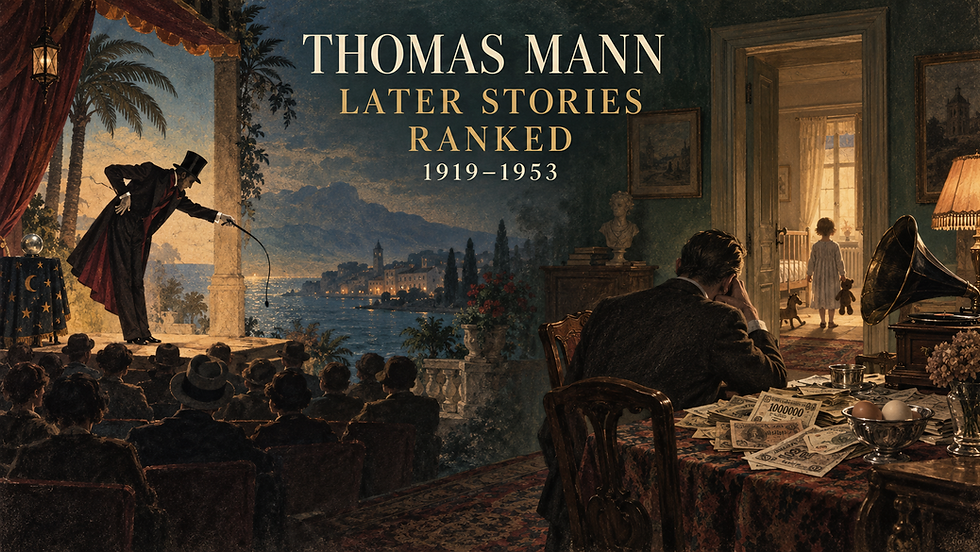
The climax is formidable. Cipolla summons the twenty-year-old waiter, whose melancholy face and delicate hands the family has noticed at the café. They know him, the narrator says in effect, humanly rather than personally. Only now do we learn that his father is a municipal clerk, his mother takes in washing, and he loves Silvestra. Cipolla converts that hidden feeling into public entertainment. Mario is made to believe that the repulsive magician is the woman he desires. He kisses Cipolla, wakes into humiliation, descends from the stage, turns, and fires twice. The parents finally lead their children out.
Mann transformed life in order to obtain this ending. The performance he witnessed with his family did not conclude in murder. According to the composition history, Erika Mann remarked that she would not have been surprised if the humiliated waiter had shot the performer; her imagined shot gave her father the novella’s decisive action. The gunfire is not reported experience carrying an attached political label. It is a formal invention that makes submission produce a consequence.
And still the narrative promise feels divided to me. The family occupies a long opening movement before Cipolla appears, and far more of the work passes before Mario is given an inner life. Their accumulated injuries prepare the moral atmosphere, but none acquires a consequence specific to them. Mario and Cipolla receive the title and the dramatic completion after the story has invested protagonist-level attention elsewhere. Allegory explains the transfer: ordinary witnesses discover that the evil surrounding their banal lives has a human face, and a socially subordinate victim performs the refusal they could not. Explanation does not entirely repair the emotional compression.
If Aschenbach had gone to Venice only to watch another artist desire, deceive himself, and die, the observer’s failure might have made a coherent political argument. It would also have been another story. In Death in Venice, every smell, warning, cosmetic touch, and beautiful shape changes the consciousness that owns the ending. In Mario and the Magician, the consciousness that has registered every warning stands near the exit and watches someone else complete the form.
Here Mann can seem to try too hard to sound like Mann. The retrospective voice interprets fatality, national character, freedom, spectacle, and will with impressive fluency. Sometimes it speaks again before the scene has finished thinking for itself. Then Cipolla raises the whip, Mario covers his desecrated mouth, and the body restores danger to the analysis.
Mario and the Magician is the later collection’s most forceful public work, and its performance sequence makes domination physically intelligible. I simply do not think its great political form and its promised personal story become identical.
3. The Tables of the Law: After Joseph, the Chisel
Mann opens his Moses story with three deductions. Moses was born disorderly, so he loved order. He killed in frenzy, so he knew that killing may be delightful while having killed is detestable. He was sensual, so he longed for the invisible and pure. Before the narrative begins moving, the contradictions have been installed.
A brilliant proposition followed by its biblical demonstration ought to produce exactly the kind of late Mann work I distrust. The Tables of the Law rises to third because the proposition becomes manual labor.
Moses is a bad and sometimes stammering speaker, a man of mixed Egyptian and Hebrew formation who needs Aaron’s fluency, Joshua’s practical competence, and the resistant people he wishes to transform. He attributes his own desire to their invisible God, then partly sees the attribution. His relation to Israel is compared to a sculptor’s relation to difficult stone. He loves the people, mistrusts them, and imagines their elevation as his work.
Law therefore comes through a compromised human maker. On the mountain, Moses discovers that divine words cannot simply be “written.” None of the available scripts will hold his people’s language in the universal form he desires. Mann makes him invent an alphabet: isolate the consonantal sounds, devise signs, combine a small set into any word. Then he must quarry, smooth, chisel, scrape, and correct the tablets. He cuts his arm and rubs blood into the letters so that they can be seen.
The novella’s great conversion makes morality material: stone dust, damaged letters, sweat, coughing, and blood used as pigment. The commandments require a legible physical form, and producing it demands skills their divine authority cannot supply. Moses’s achievement belongs at once to religion, politics, language, and art, with every elevated term held to the resistance of a material.
The people resist too. They complain, misread, panic, worship the calf, and force Moses to repeat the work after he smashes the first tablets in rage. Later he concedes that several letters on the first set had been misshapen and that rage gave him a furtively welcome excuse to begin again; the second draft comes out better. His own violence remains inside the command against killing, while revelation acquires something uncomfortably like revision. Mann never lets civilization pretend that it emerged from innocence. Restraint is made by creatures who know the attractions of what they forbid.
The timing confirms the suspicion that this is a satellite work without deciding its value. An anti-Nazi Ten Commandments film proposal failed, and Armin Robinson recast it as an anthology. He invited Mann to contribute—apparently imagining an essayistic introduction—while Mann conceived the whole Moses story. Mann completed Joseph the Provider on 4 January 1943, began The Tables of the Law fourteen days later, finished on 13 March, and reopened the plan that became Doctor Faustus the next day.
The vast archaeological and psychological play of Joseph gives way here to headlong, sometimes coarse compression. Rather than illustrating one commandment, Mann seized the whole Moses story. After four novels of mythic elaboration, he treats brevity itself as a subject. Ten laws must be reduced far enough to travel and cut deeply enough to remain.
The external purpose returns at the end. Moses curses a future ruler who will teach people to lie, murder, rob, rape, and call natural license a god. The unnamed Hitler will sit on a golden throne, spill blood, and finally be cast beneath the earth. The historical urgency is just. The seam is also visible. For a moment, the ancient human comedy stops generating its own implications and delivers the commissioned verdict.
That visible joint may help explain why the novella remained more impressive than affecting in my memory. Moses dominates; Israel often appears as the stubborn material he works. The wit, speed, and intellectual confidence are easier to recall than an individual hurt. Still, the central image has grown since I read it. A law does not descend already legible. Someone must invent the letters, wound his arm, and try again after breaking what he made. Few stories have given abstraction such weight.
2. The Black Swan: Death Returns as Desire
The German title Die Betrogene can be glossed as The Deceived Woman or The Betrayed Woman. Willard R. Trask’s authorized translation was published under the less literal English title The Black Swan. The difference matters. The German decides that someone has been deceived; the English gives us an image whose meaning must be discovered. By the end, Rosalie von Tümmler will refuse the first verdict’s moral force.
Rosalie is a fifty-year-old widow living in Düsseldorf around 1925 with her children. Her twenty-nine-year-old daughter, Anna, has a club foot, an exact intelligence, and an allegiance to modern abstract painting. Her adolescent son, Eduard, engages Ken Keaton, an American veteran of about twenty-four, as an English tutor. Ken’s young body already contains history: a war wound has cost him a kidney and left him with a disability pension. Rosalie’s attention settles on his shoulders, legs, narrow hips, and youth. In this late variation on Death in Venice, it is the older woman who looks.
Her desire takes shape within an argument she is already conducting with her body. The climacteric feels to Rosalie like expulsion from nature, whose seasonal renewal she reveres. Anna distrusts that religion. Their disagreements could have become detachable positions—nature and intellect, embodied femininity and abstract form—but affection gives both women more than a thesis to defend. Rosalie knows what Anna’s disability and renunciation have cost. Anna sees her mother’s vulnerability and tries to protect her without mocking the life inside it.
The novella lets smell know more than either of them. During an early walk, an apparently erotic musk rises from a fly-covered heap of filth. Elsewhere in Düsseldorf’s Hofgarten, an old oak carries dead limbs and new leaves at once. Warm dampness, flowers, water, rot, and animal odor keep refusing the border Rosalie draws between fertile nature and death. These are obvious clues once the ending is known. Before it, they make her faith materially persuasive. Renewal and decomposition do not alternate; they issue from the same ground.
Then bleeding returns after her menses have ceased. Rosalie reads it as menstruation, bodily confirmation that love has restored her womanhood. Her shame loosens. She allows herself to imagine that her feeling for Ken belongs to life rather than to a ridiculous refusal of age. Anna notices what the interpretation excludes: pallor, pain, and fatigue.
Mann could have made the error purely psychological—a lonely woman seeing what she wants to see. He gives the deception a harsher precision. The bleeding is real evidence produced by the disease that will kill her. After surgery reveals advanced cancer, the novella’s doctors reconstruct a probable ovarian origin whose hormonal effects have altered the uterus and imitated returning reproductive function. Within Mann’s medically disputed fictional design, death does not hide behind an unrelated sign of life. It manufactures the sign.
The excursion to Holterhof Castle condenses the whole design. Rosalie eats stale bread that Ken has warmed inside his clothing, although it was brought for the black swans. One of them hisses. Inside the old building, concealed architecture leads Rosalie and Ken into a damp private chamber decorated for dead pleasure. A blindfolded Cupid holds something like a torch. There they embrace and kiss; she promises to come to his room that night. The liaison is never consummated. A severe hemorrhage intervenes, and medical examination replaces erotic anticipation with diagnosis.
The sequence approaches over-insistence: old bread, dark water, the hissing bird, hidden passage, wet air, blind love, womb, blood. I can feel Mann arranging the correspondences and feel the arrangement become physical. Rosalie tastes the bread and breathes the room’s dampness; blood interrupts a promise at a particular hour. The strongest correspondences work through what she tastes, breathes, and suffers, giving the symbolism a physical consequence.
Adorno identified the decisive inversion. Earlier Mann often wrote of life longing for death; here death itself is ravenous for life. He also praised the exact imagination that could lodge erotic perfume inside the odor of waste. I would extend the point: such precision makes the old Eros-and-Thanatos theme unstable at the level of sense. Smell cannot tell Rosalie where attraction ends and putrefaction begins; blood cannot tell her whether youth has returned or illness has advanced.
The diagnosis clarifies cause within the story. It does not have the last word about meaning. During her final weeks, Rosalie rejects Anna’s language of cruel betrayal. If death approached under the shape of resurrection and desire, she chooses to receive the experience as grace. This does not turn cancer into a gift or prove her first interpretation right. It means that the story’s diagnosis cannot retroactively make her renewed capacity for love unreal.
Rosalie’s final judgment gives the German title a narrower authority: she has been deceived about her body, but refuses to call her renewed desire worthless. Mann planned that reconciliation before drafting, along with the cancer reversal. Its force lies in the difference between knowing an ending and experiencing the evidence that makes her judgment possible. He nevertheless confessed while writing that Rosalie and Ken did not fully engage him, and some of the connective dialogue bears the strain. Ken remains less a person than the beautiful, historically wounded occasion of Rosalie’s return to desire.
The comparison with Death in Venice reveals the remaining distance. Aschenbach aestheticizes the youth he watches and recruits every warning into his private style. Rosalie looks, speaks, bleeds, acts, and finally reinterprets the title’s accusation. Her novella lacks the earlier work’s sustained formal force, but it grants its desiring figure a late freedom Aschenbach never achieves: she can be wrong about her body without surrendering ownership of what the error meant.
1. Disorder and Early Sorrow: History Sits Down to Dinner
The best late story begins with dinner.
The Cornelius family eats croquettes made from turnip greens, followed by a powdered dessert that tastes like almond soap. The professor earns a million marks; eggs cost six thousand each. His children and servant will visit the shop separately under false names because each household is allowed only five. Their villa survives from before the war, elegant in outline, broken in detail: repairs cannot be made, iron stoves and long pipes disfigure the rooms, good clothing has been turned and worn again. The children accept themselves cheerfully as members of the “villa proletariat.”
History is already at the table before Professor Abel Cornelius, a historian, can explain it.
That order is the story’s achievement. Inflation is not background information attached to a domestic plot. It determines what the family eats, how many identities a person needs to buy eggs, which clothes can be worn to a party, who looks like a son and who looks like a servant, how a house feels to those born before and after its decline. Social transformation becomes comic household procedure.
The family names its generations as if time had moved into the dining room. Ingrid and Bert, eighteen and seventeen, are the “big folk.” Their parents are the “old folk,” although Cornelius is only forty-seven. His own parents are the “ancients.” Five-year-old Ellie and four-year-old Snapper are the “little folk.” The labels are affectionate; they also divide people more decisively than conventional rank now can. Bert and Xaver, the young servant, wear the same long hair, belts, sandals, and manner. Watching from a window, Cornelius cannot always tell which one is leaving through his gate.
The young have made improvisation a native language. Ingrid and Bert perform false identities on buses, telephone dignitaries as invented people, plan theatrical and cabaret futures, and speak slang their parents can barely follow. What exhausts the mother and unsettles the father feels to them like material for play. They do not deny the unstable world. They have no earlier one with which to compare it.
Cornelius does. His profession gives his discomfort a philosophy. He loves history once it has happened—coherent, disciplined, completed, and therefore dead. The present offends him because it is still being made. He values impartiality, then suspects that historical justice itself may be melancholy, secretly attracted to lost causes because only loss makes them available to contemplation.
His favorite child seems to offer refuge from that problem. Ellie is small enough to appear timeless. Cornelius treats his love for her as an uncorrupted human permanence set against political disorder. The narration stays close enough to his thought to make the tenderness real and far enough away to reveal the bargain inside it. He loves new life partly because he can imagine history has not touched it.
The party ruins that arrangement. Young people gather in borrowed evening clothes, smoke, eat brown-bread sandwiches, and dance to gramophone records whose rhythms sound foreign and monotonous to the father. Max Hergesell, an engineering student, briefly dances with Ellie. She is enchanted. Then he returns to a partner nearer his age, and the child discovers a form of grief she cannot name. She asks why Max cannot be her brother.
The pain exceeds anything that has happened. Max has done little wrong, and Ellie cannot grasp the temporal fact that excludes her. Cornelius cannot explain desire without destroying the innocence through which she experiences it. Her sorrow is both absurd and complete, a first wound delivered by age difference inside a house obsessed with generations.
Max comes to the nursery. He performs the fairy prince for Ellie, leans over the crib, quotes a song, promises that she will be wonderful when she grows up, and makes her happy enough to sleep. He also plays to her father. Cornelius hears the young man’s tact, vanity, kindness, and amused consciousness of the role all at once. His response is one of Mann’s exact emotional compounds: gratitude, embarrassment, and hatred.
That hatred completes the father’s diagnosis. Max can move lightly within the present and reach Ellie where paternal permanence cannot. Cornelius is thankful because the child has been comforted; humiliated because someone else had to comfort her; jealous because her grief and relief belong to a life in which he is no longer the sole necessary figure. His private refuge has acquired another person and therefore a future.
At the end he watches Ellie sleep. Childhood, he tells himself, places a deep gulf of forgetting between one day and the next. Tomorrow Max will be a pale shadow; she will play the old games with Abel and Snapper. The consolation is loving and evasive. Ellie may forget the young man, but the reader cannot return with Cornelius to the idea that she stands outside time. Early sorrow has begun.
Why is Disorder and Early Sorrow one of Thomas Mann’s best stories? Because every large claim travels through an object, relation, or act that can contradict it. Hyperinflation is six-thousand-mark eggs and a middle-class house unable to repair its washbasin. Generational change is a father unable to distinguish his son from his servant at the gate. Historical melancholy is possessive love. The present is a dance performed in pinching shoes. Social disorder and a child’s first heartbreak do not symbolize each other; they share a structure of value changing faster than consciousness can accept.
A comparison with Klaus Mann’s fiction finds Thomas unexpectedly more avant-garde here because he refuses the mythological or literary superstructure he often placed above experience. I would put the point more materially. Here the household does the thinking. Prices, clothes, rooms, jokes, music, and forms of address create the historical argument before Cornelius can turn it into a lecture.
The story remains too one-sided with the father. Ingrid and Bert are vivid as motions, voices, costumes, and irritations, but we receive little of their inward relation to the new world. Cornelius observes youth more fully than he can interpret it, and the narrative—however ironical—rarely leaves his field long enough to grant the big folk an equal center. The limit is thematically apt and remains a limit. A story can illuminate a blind spot while continuing to look through it.
Mann turns his prior idea into a limited consciousness and lets the family correct him. Cornelius’s response to the decisive experience becomes the climax itself; in Mario and the Magician, the narrator’s compromised spectatorship prepares a climax enacted chiefly by others. The person who begins Disorder and Early Sorrow owns the wound at the end.
What Changed in Thomas Mann’s Later Short Fiction?
Decline sounds like the obvious answer, although these works make it an inadequate one.
Mann himself described his shorter fiction as grouped around the large novels it accompanied. The chronology makes the arrangement unusually visible. A Man and His Dog and Song of the Little Child stand between the polemical labor of Reflections of a Nonpolitical Man and the resumed work on The Magic Mountain. The film conception for Tristan and Isolde belongs to the years of that novel. Disorder and Early Sorrow follows its completion. Mario and the Magician emerged while the Joseph project was swelling; The Transposed Heads interrupted the movement toward its final volume. The Tables of the Law began two weeks after Joseph the Provider ended and just before Mann reopened the Faust plan. The Black Swan later interrupted his return to Felix Krull.
Perhaps Mann put all his mojo into the novels.
Several late pieces really are interludes, commissions, adaptations, or formal experiments beside larger projects, and their occasions often supplied a structure before composition began. Proximity to a novel cannot explain artistic thinness, however. Death in Venice began as a possible quick interlude connected to Felix Krull. Mann’s own retrospective phrase supplies the better test: creation has its own laws. That novella outgrew its proposed function because Aschenbach’s perception generated consequences the initial plan could not contain. The inverse example is just as revealing: The Magic Mountain itself began as a short comic pendant to Death in Venice and became a major novel.
The distribution of consequence separates the later eight. The Transposed Heads makes three people die on schedule for a philosophical demonstration that calls itself an illustration. Tristan and Isolde remains a conception whose gestures await actors. Song of the Little Child asks an infant to carry much of her father’s cultural reconciliation, though her needs keep interrupting it. The Tables of the Law lets Moses pay for abstraction with labor, damaged letters, rage, and blood, although the commissioned political purpose returns at the close.
The contrast between Mario and the Magician and Disorder and Early Sorrow makes the distinction clearest. Mario converts fascism into atmosphere, bodily compliance, erotic humiliation, spectatorship, and violence, even as its personal center moves toward two men introduced late. Disorder barely announces a public thesis at all; history speaks through food, clothing, class resemblance, music, and one father’s compromised love. Its center holds because the experience changes the person watching it.
The Black Swan shows why a foreknown conclusion need not exhaust a story. Mann planned both the diagnosis and Rosalie’s reconciliation with nature. Between them, however, he makes the same bodily evidence sustain incompatible interpretations, so that discovering the medical cause leaves her judgment of the experience unsettled.
The difference lies in where Mann places the cost of what he knows. The older writer possessed more history, myth, psychology, technical memory, and command than the young one. In the novels, that abundance could become an inhabited climate. In the shorter works, knowledge can remain above the action, distributing roles without submitting to their consequences. His late stories are greatest when someone at the center must pay: Moses wounds his arm to make law legible, Rosalie’s blood sustains incompatible meanings, and a child’s tears make a historian experience the future he would prefer to study only after it is dead.
If you are deciding where to begin with Thomas Mann’s later short fiction, start with Disorder and Early Sorrow. Read The Black Swan next, then Mario and the Magician; its fourth-place position matters less than its value as a disagreement. Follow with The Tables of the Law if you want to see Mann compress the mythic intelligence of the Joseph books into a harder, quicker form. Read A Man and His Dog when slowness itself sounds like the desired subject.
The larger novels remain the necessary continuation. The Magic Mountain and Doctor Faustus show what happens when Mann’s recurring oppositions have hundreds of pages in which to cease being oppositions and become worlds.
The family in Torre di Venere leaves after Mario fires. It has read the atmosphere, endured its petty forms, known the indecency of the spectacle, and still required a near-stranger to break the spell. In the Cornelius house, nobody fires a weapon. A five-year-old asks an impossible question, a young man says good night, and a father sits beside a bed. Because every intelligence in the story has to pass through that small hurt, the quieter ending reaches further.
Sources and Editions
1. Thomas Mann, Mario și vrăjitorul: Povestiri 1919–1953, trans. Ion Roman (Humanitas Fiction, 2022). Based on Gesammelte Erzählungen (Collected Stories), Frankfurter Ausgabe, Späte Erzählungen 1919–1953, edited by Peter de Mendelssohn (S. Fischer, 1981). Publisher’s copyright page and contents.
2. Thomas Mann, Stories of Three Decades, trans. H. T. Lowe-Porter (Martin Secker & Warburg, 1936). Primary English texts for A Man and His Dog, Disorder and Early Sorrow, and Mario and the Magician, plus Mann’s retrospective account of the short works gathered around his novels. Digitized edition.
3. Thomas Mann, Herr und Hund / Gesang vom Kindchen. Zwei Idyllen (S. Fischer, 1919). Digitized first edition.
4. Thomas Mann, Fiorenza, Gedichte, Filmentwürfe, ed. Elisabeth Galvan, GKFA 3.1 (S. Fischer), and Mann’s 1924 essay “Über das Filmmanuskript ‘Tristan und Isolde.’” These establish the form and surviving status of the nine-page scenario and Mann’s proposed language for silent cinema. Official edition; Mann’s essay.
5. Volker Mertens, “Mit Wagners Augen? Thomas Manns ‘mittelalterliche’ Werke: Tristan-Film und Der Erwählte,” Thomas Mann Jahrbuch 25 (2012), pp. 129–144. Mertens’s close comparison qualifies Mann’s account of bypassing Wagner: the declared Gottfried source remains Wagner-haunted in structure and psychology. Journal volume.
6. Thomas Mann, The Transposed Heads: A Legend of India, trans. H. T. Lowe-Porter (Secker & Warburg, 1941). Primary text for the head-body exchange, the narrator’s “illustration” formula, Sita’s death, and Andhaka’s costly synthesis. Digitized edition.
7. Thomas Mann, The Tables of the Law, trans. H. T. Lowe-Porter (Secker & Warburg, 1947). Primary English text for Moses’s alphabet, blood-darkened letters, broken tablets, revision, and closing political curse. Digitized edition.
8. Thomas Mann, The Black Swan, trans. Willard R. Trask (Alfred A. Knopf, 1954; University of California Press, 1990). Reference edition for the authorized English title and the novella’s female late-life counterpart to Death in Venice. Publisher’s edition page.
9. Hans Rudolf Vaget, Späte Erzählungen 1919–1953: Kommentar, GKFA 6.2 (S. Fischer, 2021). The principal composition and textual-history source for the seven canonical late narratives, drawing on manuscripts, diaries, correspondence, publication records, and Mann’s medical consultation. Vaget also preserves Adorno’s reading of “life-hungry death” and summarizes Friedhelm Marx’s comparison of Disorder and Early Sorrow with Klaus Mann’s Kindernovelle, the two critical contributions engaged in the essay. Open critical commentary.


Comments